


Block XYZ 0.00%↑ dropped a bomb in their earnings report yesterday. The company plans to cut ~40% of its workforce, or roughly 4,000 people out of a total 10,200, as part of a significant restructuring focused on positioning the company to be "intelligence-native”.
As of this writing, Block’s stock is up 13% today. Why? Two reasons I’ll explore in this post.
Bloat & Block
Here’s CEO Jack Dorsey’s email to the company - it’s worth clicking on and reading in full.

Jack frames the decision simply:
“we’re already seeing that the intelligence tools we’re creating and using, paired with smaller and flatter teams, are enabling a new way of working which fundamentally changes what it means to build and run a company. and that's accelerating rapidly.”
“we’re going to build this company with intelligence at the core of everything we do.”
Twitter and news media are blowing up with the narrative that AI is taking people’s jobs.
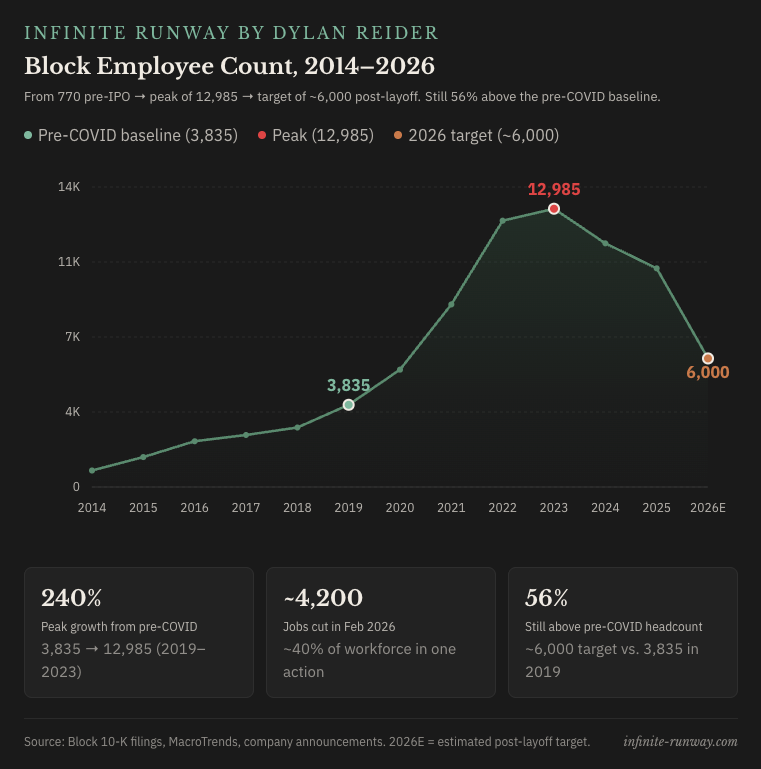
The truth is that with the announced cuts, Block is trimming down to roughly 6,000 employees, still 50% larger than the 3,800 employees in its pre-covid, pre-hiring spree state.
As all bubbles do, the 2021 ZIRP era got the best of many of us. Block included. They grew from 3,800 to 13,000 employees between 2019 and 2023, and they’ve been trimming and restructuring since then. Now this is Block ripping the bandaid off.
And it follows a trend that other major tech companies pursued over the last few years in an effort to get fit. Meta laid off nearly 20% of its workforce across cuts in 2023 & 2024. Amazon, Google, Spotify, and others did too.
The difference is that in 2023, companies called it “efficiency”. In 2026, they’re calling it AI.
Leverage & Action
Going back to the beginning of this post - the market rewarded Block’s stock for two reasons.
The first reason: Leverage.
As I wrote in my 10 themes for 2026, AI is the corporate equivalent of a GLP-1 - it helps companies lose weight (cut costs) and reduce cravings (eliminate redundant hiring), while retaining muscle (growing revenue).
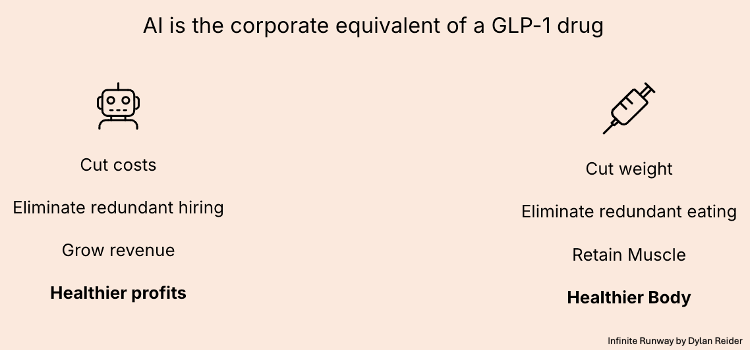
Healthier profits = leverage. Fewer people and growing revenue means more free cashflow.
Block guided to $3.66 of EPS vs. consensus at $3.22, a meaningful beat supported by expectations of operating leverage this year.
Meanwhile they grew gross profit 24% Y/Y to $2.87B in 4Q, well ahead of guidance of $2.75B (19% Y/Y).
On top of that, Cash App monthly active users grew from 59M, up from 57M last quarter - breaking 6 quarters in a row of no growth.
And don’t forget, this is all happening against a backdrop of Block trading at a very cheap multiple of 12x 2027 EPS prior to today’s move in the stock.
In sum, Block’s top-line is doing well, but the bottom-line needed to be improved. Now Block is making a commitment to investors that it will be - a $2M gross profit per employee target, 4x their $500k gross profit per employee level from 2019-2024.

Everyone is talking about AI, but the market has one metric to rely on that proves whether or not companies are actually embracing it internally, and that is operating leverage.
But the stock market’s reaction reveals something deeper.
The second reason for the move in Block’s stock: Action. Drastic action.
The Citrini report that came out at the beginning of the week painted a scenario where by 2028, AI’s success wreaks havoc on the economy due to rising white collar unemployment. I tweeted my own pushback against that scenario, as did many others who argued the piece's inconsistencies and self-serving co-author who was short the stocks mentioned. Either way, the debate from it showed there are real investor jitters about companies that will be slowly boiled as AI reshapes their industry - only once they realize what’s happened, they’re cooked.
So if you’re a tech CEO, taking action to ensure that isn’t your company is important.
However, without the AI framing, cutting 40% of your workforce looks like you’re going into a PE-style, cash-generating “maintenance mode” of low-growth but high profits.
With the AI framing, cutting 40% of your workforce looks like vision.
The thing is, whether this is about cutting a bloated cost structure or embracing AI, it doesn’t matter. AI gave Jack a narrative framework to do what needed doing - get his company ready for the AI era.
And it may be that the market is rewarding that decisiveness as much as the numbers, regardless of which story - AI or cutting bloat - is true.
The delta between companies that aggressively embed AI into their operations, and those that are slow to do so, will widen every year. Investors are sending a clear signal that now is the time to get aggressive about putting AI into every element of your business. Or as Jack put it, become “intelligence-native”.
The companies that build the AI muscle now will compound their advantage over their competitors in the next five years.
If you think the boards of software companies with hollowed out valuations, bloated cost structures, and stock-based compensation that exceeds 100% of free cashflow are watching this and asking themselves, “should we do this?”, then trust your instincts.
A harbinger
The market’s feedback is clear: companies with bloated cost structures should take drastic action towards improving profitability. AI provides the cover to do so, and Block will not be the last company to do a headline-grabbing workforce restructuring.
As my friend and fellow venture capitalist Finn Murphy pointed out in an eloquent post on X, Salesforce has 76,000 employees. One of which is Matthew McConaughey, who earns millions of dollars a year as a creative advisor for the company (read: to hang out with Benioff).
It’s easy to pick on Salesforce, but many large and even mid-sized publicly-traded software companies are overdue for a right-sizing of their workforce.
Consider Atlassian, which has 13,800 employees. Nearly half sit in their engineering organization, which they pour over half their revenue into - one of the highest R&D-to-revenue ratios in enterprise software. Jira and Confluence are not exactly reinventing themselves every quarter. Everyone agrees AI coding tools are making engineers much more productive, so the market is now reasonably asking for proof.
If software CEOs have the fortitude to right-size their business the way Jack did, it should result in them being meaningfully more profitable, healthier businesses. As undrvalue on X put it in his spot-on article about AI enabling software companies to become more profitable in the coming years:
“Any company with 75%+ gross margins, a meaningful SBC burden, and a product that can be maintained and extended with fewer people has the same latent operating leverage coiled inside it. The AI bull case for software isn't about revenue acceleration - it's about what happens to the cost structure when growth no longer requires proportional headcount growth.”
AI’s Uneven Reality
Job cuts, whether driven by AI or not, will increasingly be perceived as AI taking jobs. That creates a real challenge for society across multiple dimensions.
The media, politicians, and those who seek to trade controversy for attention will seize on every layoff announcement as evidence of an AI jobs apocalypse.
The truth is these cuts are concentrated among companies that over-hired, face structural headwinds, and are dealing with tough investor questions about the value of their business in a world reshaped by AI.
Still, it’s a period of digestion for many companies, which means layoffs. That’s uncomfortable, and the human cost is real.
But plenty of companies are still actually hiring aggressively. Especially those benefitting from AI, or building AI applications, AI infrastructure, and companies across the economy looking to refresh their workforce with people who are AI-native.
If you’re looking for a new role, Ali Rohde has an awesome weekly newsletter featuring great jobs across the tech ecosystem. And Bill Gurley is out with a new book about “how to thrive in a career you love”.
Like all creative destruction, this transition period will end up being good for the economy as capital is reallocated to higher-value uses.
The people who benefit the most will be those who embrace AI as a force multiplier in their work.
Similarly, the companies that benefit the most will be those who embed AI into their core operations. They won’t just be fit, they will be structurally better businesses than they were previously.
Whether Block is genuinely becoming “intelligence-native” with “intelligence at the core of everything” they do, or whether Jack is using AI as cover to right-size a bloated org - the outcome is the same. A leaner business with greater operating leverage.
Every tech CEO watching just learned that the market may reward them for doing the same.
Great read man!