


When reports began leaking that Giannis Antetokounmpo - one of the best basketball players in the world - was considering being traded from the Milwaukee Bucks, the entire basketball world paid attention. So did the prediction markets.
On December 4, a contract opened on Kalshi that allowed users to bet on whether Giannis would stay with the Bucks or get traded to a different team. The contract opened with the market pricing in ~30% odds that Giannis would stay in Milwaukee.
Over the following month, the Giannis trade saga became one of the biggest stories of this basketball season.
The odds that he’d stay in Milwaukee began ticking up, eventually reaching a high of 91%.
Then January happened. Giannis booed his own fans after a blow-out loss. He got injured (for the second time), and ESPN reporter Shams Charania posted on X that Giannis had told the Bucks he wanted to be traded - a claim that garnered nearly 20M views on X.
The Kalshi odds of Giannis staying in Milwaukee began plummeting, falling from 78% to 45% in a single day, and then hit 38%. Over 200,000 contracts were traded on the platform. By January 30th, Giannis’ trade situation was the highest volume contract on Kalshi.
But then - the trade deadline of Feb 5th comes and goes - no trade. Odds that Giannis stays in Milwaukee skyrocket towards 100%.
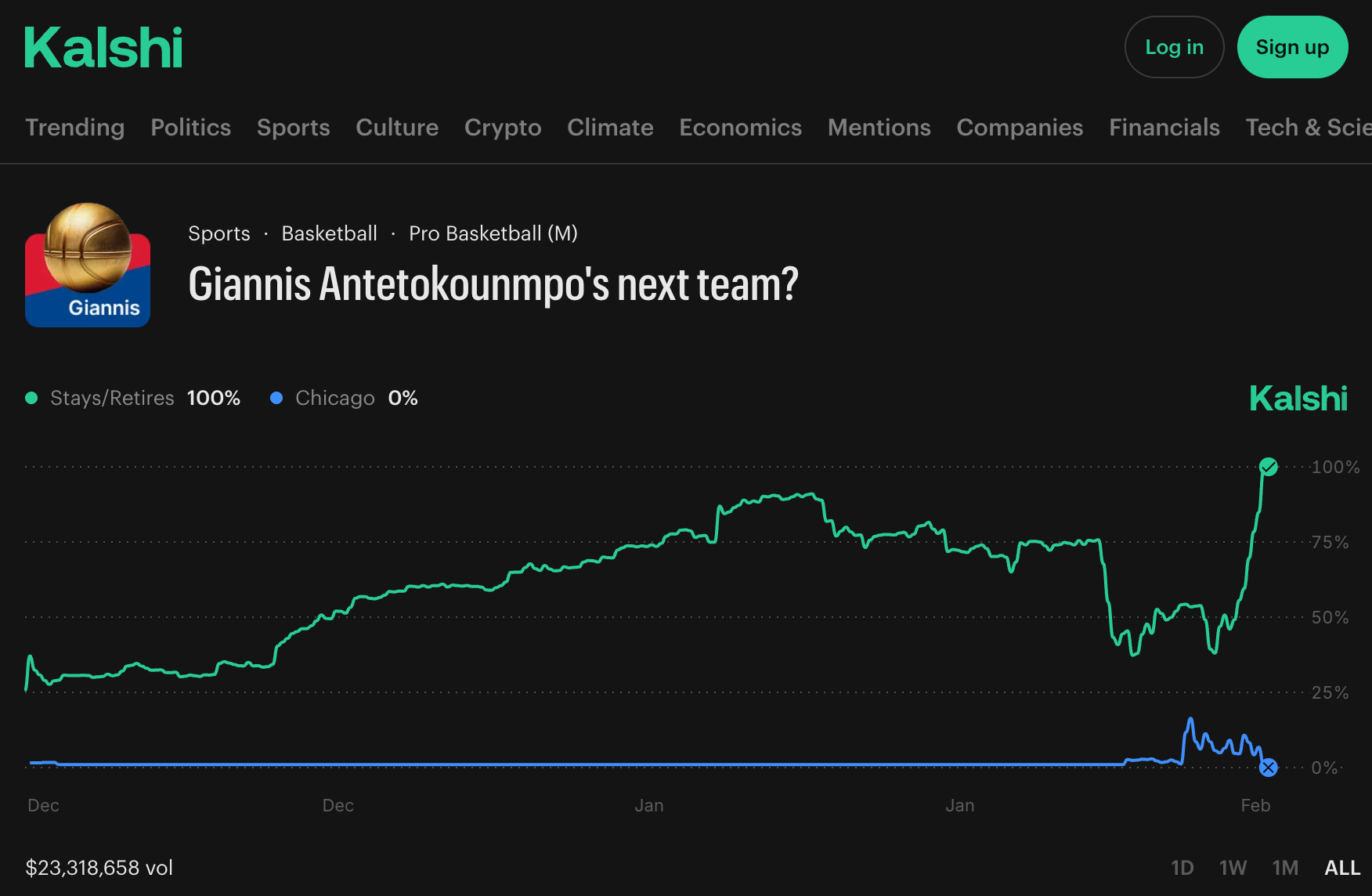
Over the 2-month Giannis trade saga, Kalshi generated $23M of trading volume on Giannis contracts.
The morning after the trade deadline, Giannis announced he was “joining Kalshi as a shareholder”, as the first NBA player to take an equity stake in a prediction market. Kalshi later confirmed the deal was signed on February 5. The day of the trade deadline.
According to Kalshi, his stake is worth “less than 1%”. A stake of 1% would be $110M at Kalshi’s last valuation of $11B.
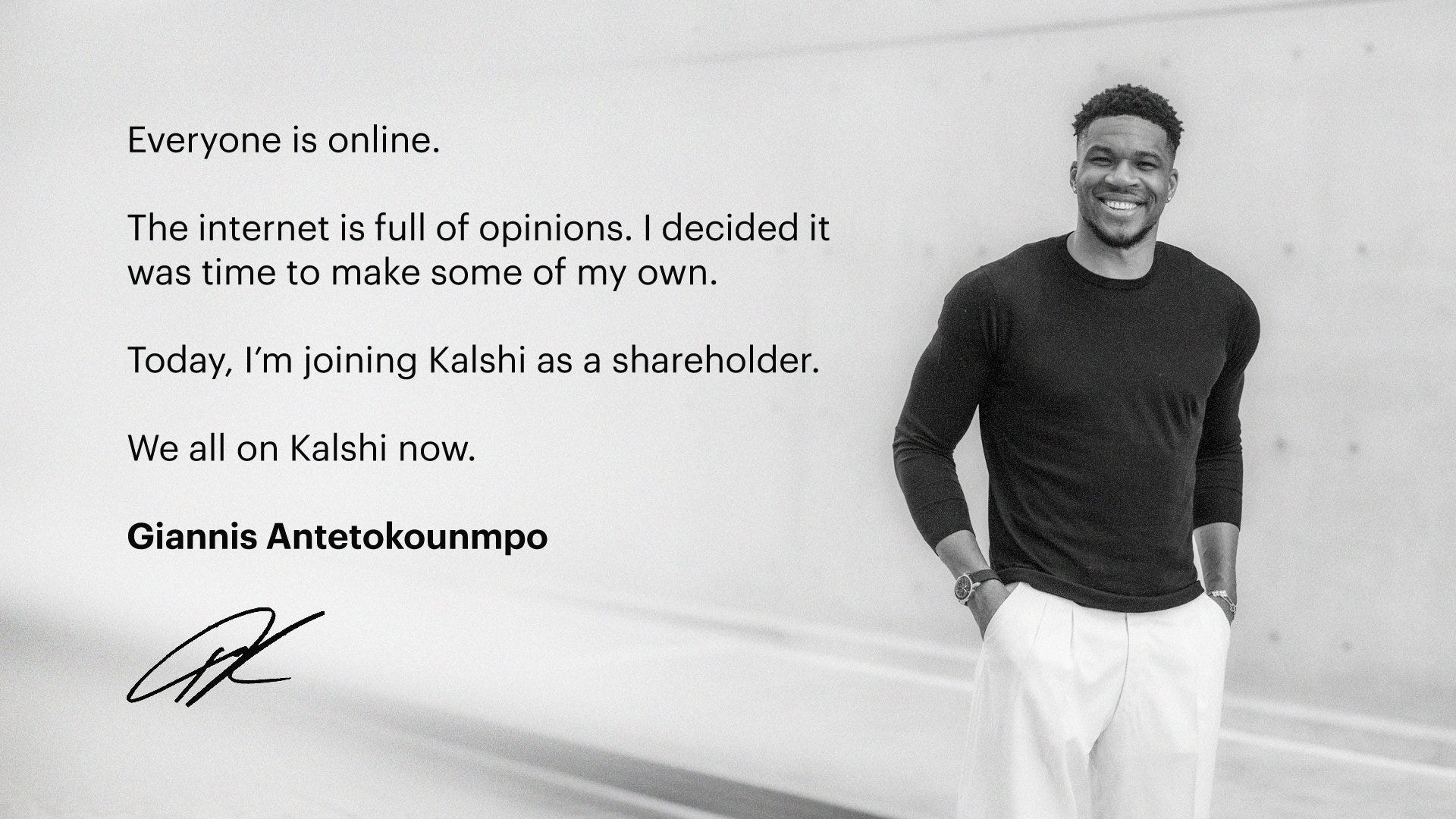
While Kalshi says Giannis is barred from trading on basketball contracts on their platform, basketball fans and the sports world called out the poor optics and perceived conflict of interest.
Did Giannis do anything wrong? Did Kalshi?
Does it matter?
The Insider Pattern
Modern prediction markets like Kalshi and Polymarket have the potential to be the most important financial innovation since Bitcoin. By enabling users to trade freely on markets across sports, politics, business, and really anything else, prediction markets create a price that corresponds to the odds of an event taking place. In doing so, they help us to better understand not just the future, but the present. Improving society’s information flow is an inherent good - for policymaking, capital market efficiency, and for consumers who can monetize their niche expertise.
But prediction markets only work if they reflect the wisdom of crowds. Recently, they’ve been reflecting the wisdom of insiders.
The Maduro trade (Polymarket, Jan-26): An account opens days before Maduro is ousted by the US military, and places a $32k bet that he will be out of power by Jan 31. Odds on the contract had been around 5% for weeks. The account netted $436k, and only traded on contracts related to Venezuela.
The Google Search Rankings Trade (Polymarket, Dec-25): An account correctly predicted 22 out of 23 of Google’s “Year in Search” rankings in a single day, making over $1M in 25 hours. The same user made over $150k correctly predicting the release date of Google’s Gemini 3 model a few months before.
The Super Bowl Halftime Trade (Polymarket, Feb-26): A day-old account placed $70k of bets on performers at the Super Bowl halftime show, including Lady Gaga and Ricky Martin, and got 17 of 18 trades correct. Another trader bet $500k on Lady Gaga making an appearance just days before the show.
The IDF Trade (Polymarket, 2026): An Israeli soldier and civilian used classified intelligence regarding upcoming IDF operations to trade on Polymarket, netting $150k. The Israeli military has since announced they charged the individuals, making it the first criminal prosecution globally for prediction market insider trading.
The pattern across these trades is obvious. First, a user creates a new wallet, and when they open their first trade, it’s in a niche market with limited public information, and they place a bet much larger than that market’s average. Their timing ends up being perfect, and usually multiple wallets coalesce around a single contract or idea. And the above trades are just a few examples - not to mention the insider trades on the Nobel Peace Prize, the OpenAI GPT 5.2 release, and too many more to list here.
In any other financial market, these trades would lead to investigations and consequences. In prediction markets, they lead to debate.
This problem is worth taking seriously, not because prediction markets are bad for society, but because they have immense potential for good. Improving how society processes information is important. That, however, is being outweighed by the risk that prediction markets become a haven for legalized insider trading.
Free vs Fair Markets
Losing sucks, and losing money sucks even worse. But market participants know what they’re getting into - whether it’s a trader in a prediction market, an investor in the stock market, or a gambler in the casino. Losing money is part of the game, but not when the game is rigged.
That is the unspoken contract by which any market is held together.
In blackjack, everyone knows the house has an edge, but people still play anyway because they understand the odds and have fun while doing it.
Gamblers view prediction markets similarly. But prediction markets go further by allowing people to monetize their niche expertise. Whether it’s sports, movies, politics, pop culture, or business.
If you’re a movie buff, you can decide if you agree with the market price that One Battle After Another wins best picture at the Oscars this year. You know the odds, and know you might lose, but you make the bet because you’ve watched every movie nominated for an Oscar this year and used Claude to build a statistical model based on online sentiment. Your passion, expertise, and skills are your edge. That is very different than the member of the Academy’s voting committee who places a big trade on the Oscar winner. Their edge is their access, influence, and proximity to the outcome.
Market participants are fine losing money to someone who made the smarter trade.
They’re not fine losing to someone who already knows the answer - or even worse, can influence it.
In What is a Prediction Market?, I wrote about the four conditions under which markets operate effectively to facilitate price discovery: Diversity of viewpoints, independent judgements, decentralized information, and an aggregation mechanism that is liquid, transparent, and hard to game. The last two are broken by insider trading, rendering the wisdom of the crowd irrelevant, and creating a transfer of wealth from the uninformed to the informed.
The prediction market platforms launched with a simple proposition: offer users maximal freedom to bet on anything. Maximal freedom creates liquidity, and liquidity is what makes markets work.
That’s true, until freedom extends to people trading on information they got from being close to the outcome itself. At the limit, freedom erodes the fairness that generates liquidity for the market to work in the first place.
To their credit, the prediction market platforms are not hiding from this debate.
The Case for Insider Trading - and Why It’s Wrong
As Polymarket’s CEO Shayne Coplan explained at a recent Axios event, markets where insiders may know the answer are distinguished by several characteristics. As he put it, “They have thinner liquidity, wider spreads, and nobody is confused that at some point in time someone may come in here…and when they do, all of the sudden it’s trading at 95 cents.”
When Coinbase CEO Brian Armstrong was asked about whether insider trading in prediction markets should be allowed, he said, “It’s not a clear cut question, because if your goal is actually for the 99 percent of people trying to get a signal about what's going to happen in the world — like, 'Is the Suez Canal going to be reopened?' — you actually want insider trading. You want some admiral sitting on a ship in the Suez Canal who has really good information to be trading so you get better signal. Now if you want to preserve the integrity of those markets, maybe you don’t want them to be trading. You may need a decentralization test. So it’s not a clear cut answer.”
There is a bit of truth here. If a researcher at the Wuhan lab in China was trading on pandemic contracts in late 2019, that may have produced a price signal visible before the Chinese administration officially acknowledged the COVID pandemic. In that scenario, the researcher is an insider, and their profit motive becomes a mechanism for whistleblowing. That’s good.
However, this argument falls apart once you extend it to people who don’t just know the outcome, but can actually influence it.
Consider Brian Armstrong’s example of an admiral in the Suez Canal. Placing a trade in a prediction market could create a distorting incentive to push for a policy because they have money riding on the outcome. Rather than asking, “when should the Suez Canal reopen?”, they ask “when did I bet it would reopen?”. The financial incentive has a distorting effect on what should be otherwise an objective policy decision.
In the US, we have already seen what happens when people trusted to make decisions are allowed to trade on the outcomes of those decisions.
Less than 20% of Americans say they trust Congress to do the right thing. That disastrous erosion of institutional trust has been supported by, among many other things, the fact that our representatives are allowed to trade stocks using information they receive as part of their job in Congress.
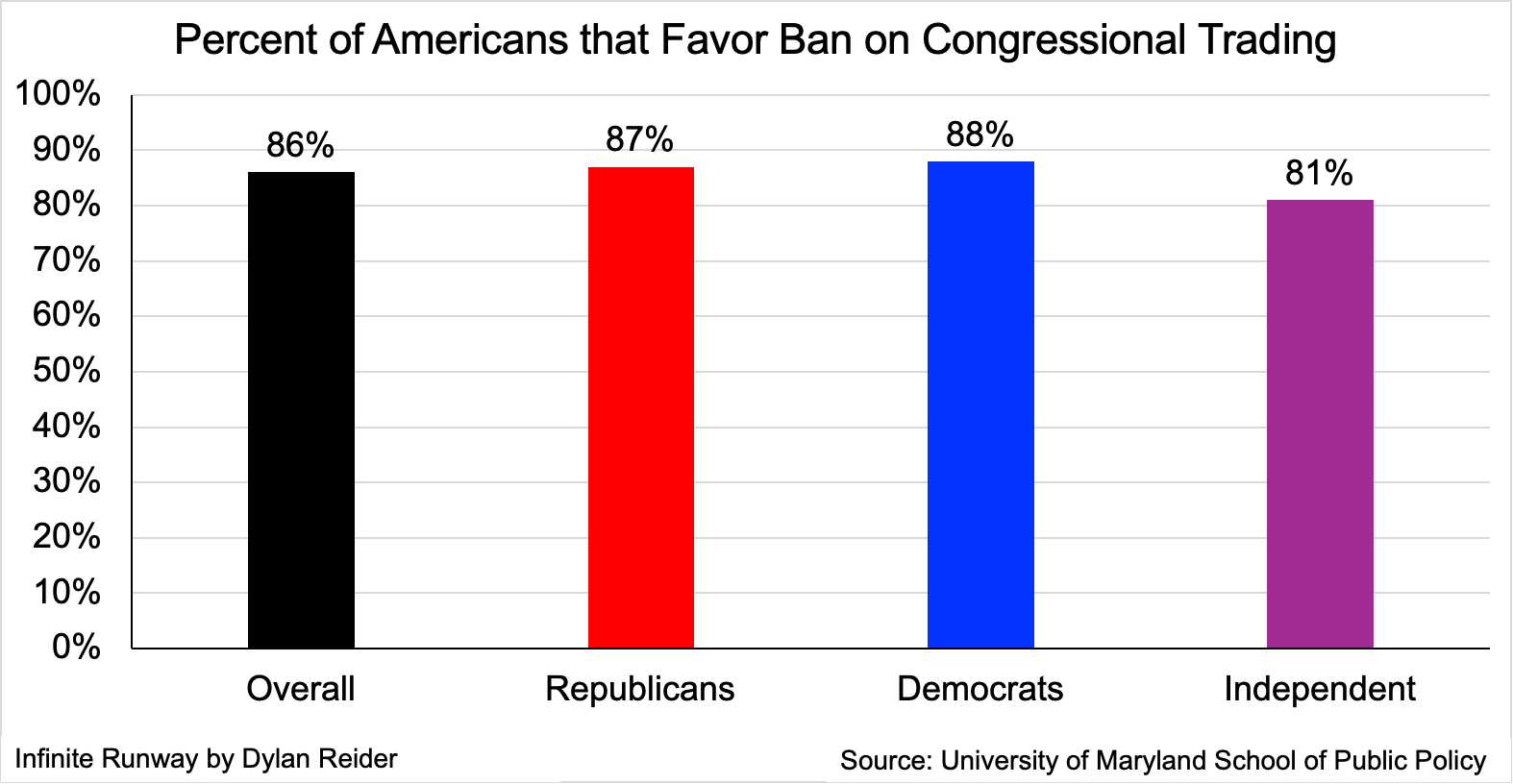
Prediction markets that lack common sense rules around insider trading risk more than being unfair. They risk scaling the same corrosive distrust that has poisoned society’s view of institutions like Congress. That pervasive sense that the game is rigged has contributed to the gambling reflex and casino economy that people like kyla scanlon have written about. The irony is that same desire to gamble has helped fuel the consumer demand powering the rise of prediction markets in the first place.
If that distrust scales across every domain prediction markets touch - entertainment, sports, policymaking, etc. - the blowback will be significant. The platforms risk poisoning the very well they're drinking from.
The thing is the prediction market platforms know this. So what are they doing about it?
The Window for Self-Regulation
In the Axios interview with Polymarket CEO Shayne Coplan, he implied insider trading in prediction markets is a feature, not a bug, as it “creates a financial incentive to divulge information to the market.” Distinguishing insider trading from outright manipulation of outcomes, he said, “We’ve got some stuff in the works that will be a great improvement around what’s existing. Integrity around the markets is really important.” Okay, not the most reassuring stance.
Kalshi has been more concrete. Two weeks ago, they announced a new independent advisory committee focused on trading surveillance. CEO Tarek Mansour laid out a clear plan on X to work with the CFTC on enforcement of insider trading, including hiring a head of enforcement.
Those are real, important steps. They also were announced the same day - February 5th - that Kalshi signed a shareholder deal with an NBA player whose trade status drove $23M of volume on their platform. That tells you how far along we are in this process.
The prediction market platforms should be moving faster. Under the current administration, the CFTC has been aggressive in claiming sole regulatory oversight over prediction markets. And as sole regulator, the CFTC’s position towards the prediction markets is to treat them as “self-regulatory organizations”. Translation: Police yourself.
Regardless of your political leanings, that position of the current administration is the most favorable and permissive regulatory environment that Polymarket and Kalshi could ever imagine. So permissive that even the President’s son is an advisor to them - yes, both of them.
This is a unique moment in time for the prediction market platforms to build real self-regulating infrastructure and institutional-grade trust. It won’t last. There is a growing swell of politicians taking aim at prediction markets. If the next administration takes a less favorable view of prediction markets, the response won’t be surgical.
What Happens Next
A new consumer category claiming to offer a public good, growing virally, operating in a regulatory gray zone, and at the center of a major debate about their impact on society.
Sound familiar? Juul. They were in a similar situation a decade ago. Juul created an entirely new consumer category with vaping. It was an innovative product, less harmful than the cigarettes that millions of Americans were addicted to. At one point they were valued at $38B. But Juul did not self-regulate. Instead, they let teenagers become their fastest-growing user base, paid lip-service to age verification, and treated regulators’ concerns as a PR issue. The societal and regulatory backlash came - under the first Trump administration, no less - and it was swift, blunt, and total. The FDA sued Juul into oblivion and investors lost billions.
Gambling, like nicotine use, is real and is not going away. But blatant insider trading, like teenagers vaping, is societally untenable and too tempting for politicians and regulators looking to pick a fight against a visible, emotionally resonant problem.
And if the current prediction market platforms don’t self-regulate, someone else will - whether a regulator or a competitor. A new entrant that counter-positions itself as a “clean exchange” - staunch on insider trading, transparency, and enforcement - would have a major opportunity to create a differentiated prediction market platform.
Kalshi’s recent moves suggest they want to be that platform. Whether those recent announcements lead to real enforcement or remain as press releases remains to be seen.
Prediction markets have a massive opportunity. Global consumer financial markets, institutional hedging, and data services represent a TAM large enough to sustain a $100B+ market cap company. None of that will happen if these markets become a haven for legalized insider trading.
The wisdom of the crowd is a beautiful idea - that humans’ collective opinion, given the right conditions, is smarter than any one expert. The prediction market platforms harness it incredibly well. But the crowds have to believe the game is fair, or they’ll leave. If insiders crowd them out, it will destroy the wisdom these platforms were built to foster. They have a window to prevent that from happening. It’s smaller than they think.