


London, 1686. Edward Lloyd opens a coffee house on Tower Street, just a few blocks away from the docks. Ship captains, sailors, and merchants come off the river Thames and walk to Lloyd’s to gather, drink, eat, and talk shop. Which ships arrived that day? Which ships were lost? Which captains mistreated their crew? Which merchants didn’t pay their captains?
This is the London that is about to take the mantle of financial capital of the world away from Amsterdam. This is the London that is the seat of an expanding British empire that is about to become the largest the world has ever seen. Shipping is the economy and a single voyage to the West Indies can make a merchant’s year, or ruin him. Insurance barely existed as an industry - there were no major insurance firms, regulators, actuarial tables. All these men had was the question of when the next ship would come home, and the information exchanged at Lloyd’s Coffee House was the closest thing they had to an answer.
In the corner would sit a handful of businessmen listening to the conversations around them, trying to get some signal about which ships would make it and which wouldn’t. They began making deals with shippers. These deals became an early form of shipping insurance, and as their business became larger, Edward Lloyd began charging them to sit at the tables in the coffee house to conduct that business.
This continued on for several decades, and eventually there was so much shipping business being conducted in Lloyd’s Coffee House that in 1734, they started publishing Lloyd’s List, a daily newspaper. Readers would learn about the day’s departures and arrivals, the cargo on each ship, where other country’s fleets were sailing, and where pirates had been seen - straight from the captains and sailors themselves. That information was so valuable that many shipping merchants were willing to pay a subscription for it. Nearly three centuries later, they still do.
That small coffee house on the Thames became Lloyd’s of London, one of the largest insurance markets in the world. It was built on the gossip exchanged there. The practice has a name, and 340 years later, it’s still the greatest edge in finance.
Scuttlebutt - originally Navy slang for the water cask on a ship’s deck where sailors gathered to trade news and rumors - like the office water cooler of the 1800s.
In 1958, Philip Fisher published Common Stocks and Uncommon Profits, one of the all-time great books on investing. He created a framework for a style of equity investing called the “scuttlebutt method”.
Fisher’s concept was to approach investing as if you were one of those merchants back at Lloyd’s Coffee House in the 1680s. If you’re interested in making an investment in a company, talk to everyone you possibly can who might know something about the business and its industry. Talk to the customers, competitors, suppliers, employees and former employees. You have to go beyond the financials, beyond the data - you need the anecdotes, the rumors, the scuttlebutt.
Warren Buffett has talked about Fisher’s type of investing a lot, including in 1998 when he credited it for his famous investment in American Express in the 1960s. He once said his investment style was 85% Ben Graham and 15% Philip Fisher. In the 2018 annual meeting, Buffett explained the scuttlebutt method was used by Charlie Munger in his famous investment in Costco, and by Ted Weschler and Todd Combs who took over Berkshire after Charlie and Warren.
Philip Fisher didn’t invent scuttlebutt investing, as people had already been doing it for hundreds of years - and probably even longer than that. But he did give it a name.
In today’s modern world of institutional investing, the scuttlebutt method is not really spoken about anymore. Not because it went away, not because scuttlebutt is a silly old-timey word (let’s be honest, it is).
It’s not spoken about because it won. The scuttlebutt method has become the foundation of how all fundamental investors do diligence on potential investments.
The modern phrase for the scuttlebutt method is primary research. The qualitative kind, which involves talking to lots of people who may have a perspective on a market you’re looking at. That’s the default setting. It’s what every serious investor does before writing a check. It’s what every corporate development team does before making an acquisition. What competitive intelligence teams do to inform their view of a market. What product teams do before launching in a new category.
Hedge funds run quarterly channel checks. PE firms build huge diligence teams to interview customers before a buy-out. Every major enterprise has corporate development and corporate strategy teams made up of people who could just as easily be running due diligence at a PE firm.
The specifics vary, but the method doesn’t. Every one of those processes is Philip Fisher’s scuttlebutt method, institutionalized and rebranded for modern investing as primary research.
A career of scuttlebutt
The summer of 2016 was the first time I did real investment research. I was working as an intern at Folger Hill Asset Management, a spin-off of Point72. The PM I worked for asked me to research Advance Auto Parts, the auto parts retailer, and bring him my point of view on the stock after two weeks of research. He gave me four research reports on the stock - from Goldman Sachs, JP Morgan, Morgan Stanley, and Cleveland Research. I asked him what this Cleveland Research company was, and he explained to me that even though I’d never heard of them, they were his favorite research provider on Wall Street for the stocks he covered.
I ended up joining Cleveland Research after college as a sell-side equity analyst, and it was my first exposure to enterprise tech companies. I covered businesses like Cisco, Palo Alto Networks, VMware, Arista, Splunk, Okta, and others. Cleveland was and is unique on Wall Street because they do one thing and one thing only - primary research. They build personal relationships with people in their covered companies’ ecosystems including customers, suppliers, competitors, ex-employees, and anyone close enough to the business to see it clearly.
Every quarter I’d call the same people, and ask the same questions. How’s business going? What did you think of this new product? What are you hearing from customers? How do you expect next quarter to go? What are you hearing from the management team that’s misaligned with what you’re seeing on the ground?
We would then synthesize those calls and write reports from the information we gathered, and sell it to hedge funds and asset managers that traded the stocks we covered.
At the time, I didn’t know I was running a playbook that dated back to a London coffee house from the 1680s.
After two years at Cleveland Research, I joined Alex Zukin at RBC, where I brought the primary research method I learned at Cleveland Research to the stocks his team covered. We ended up being ranked #1 on Wall Street by Institutional Investor in 2020, and we were slated to be on the UiPath IPO, which is when I met Brandon Deer and Daniel Dines.
In my first interview with Brandon, he asked me how I did research on the stocks I covered. I explained to him that I became friends with lots of people in the company’s ecosystem, which for UiPath included their major channel partners like the big 4 consulting firms. What started as a job interview became him asking me about what I was hearing from them. He ended up hiring me to help build Crew Capital with him and Daniel.
From public stocks to early-stage venture, the one through-line of my career has been figuring out what’s happening on the ground and using that to inform my investment thesis.
Information is the oldest edge in finance, 340 years after Edward Lloyd opened his coffee house. What’s changed is how it gets obtained and by whom.
Three eras of primary research
The scuttlebutt era ( ? - 1998). Since at least the 17th century, but probably since the beginning of human commercial activity, people used information to get an edge in business. In the 20th century, that meant Philip Fisher-style information gathering. You built personal relationships and worked your rolodex trying to gather anecdotes to paint a picture of a business. It took a career to build relationships with the people who were in the know. If you couldn't, you didn't have the signal.
The expert network era (1998 - 2024). GLG launches in 1998 and productizes scuttlebutt. Any corporation or investment firm can use GLG to procure very specific expert personas and get them on an hour long phone call. Calls run upwards of $1,000-3,000 and a multi-billion dollar industry is born with Guidepoint, Third Bridge, AlphaSights, and more.
The era peaked when GLG filed to go public in October 2021 at the top of the ZIRP cycle, then pulled the IPO months later. Meanwhile, Tegus was already changing the shape of the industry, growing from $13M in ARR at the start of 2021 to $100M by the end of 2022 by inverting the privacy model. Instead of keeping expert calls private, Tegus clients opted into sharing their transcripts with every other Tegus client. That shared library became so valuable that AlphaSense acquired them for $930M in 2024.
Expert networks solved access. They didn’t solve synthesis. A human still had to run every call, take notes, and make sense of twenty 20-page transcripts. You could buy more calls. You couldn’t compound what you learned from them. Every call was a one-time transaction, consumed by one team, stored in their heads and in their notebooks.
Worst of all, there was no way to approach expert calls with any rigor. You could ask a competitor’s executive how the landscape was changing, but you couldn’t quantify it or measure it repeatedly over time. You had to go off their tone and your gut, just like the merchants at Lloyd’s Coffee House did.
That’s changing with AI, and with Qualitate.
Investing in Qualitate
In January 2024, a friend in venture forwarded me a deal he’d passed on. The email said “Qualitate AI - captures voice data from thousands of technology buyers across 400+ technology markets”. Something clicked. The founder was trying to use AI to do the thing I’d spent my career running by hand. After meeting Sagar Kadakia and coming to a shared vision for the company, I led Qualitate’s first financing round. I wrote more about the story last week.
Two years after I first invested in the idea of Qualitate, Sagar has built the company into a multi-million-dollar-revenue business serving some of the largest tech companies, private equity firms, hedge funds, and asset managers. Their team is now 25 people, all working in-person from their office in New York.
Here’s how it works.
Data platform. Qualitate’s AI runs thousands of expert conversations in parallel, transcribes them, and aggregates them into a single queryable dataset. Customers ask it questions the way they’d ask a research analyst. How have agentic coding tools impacted build-vs-buy decisions at large enterprises in 2026? Qualitate scans the full dataset and returns an answer grounded in direct quotes from specific transcripts, with the underlying conversations one click away.
Custom AI Moderator. Customers can also run their own custom research through Qualitate’s AI moderator. It generates surveys, makes a plan, interviews experts, and synthesizes the insights from all of the interviews. Research teams can massively scale up their operations without increasing their overhead.
Agentic workflows. Customers can embed Qualitate’s data into the tools they already use, triggering workflows across their business. For example, interviewing an expert, interviewing an employee, analyzing a data room, generating an investment memo. All of it powered by the largest structured database of primary research in the world.
The Continuous Intelligence Era (2024 - ?)
Qualitate has ushered in the third era of primary research, the continuous intelligence era. If the scuttlebutt era was built on relationships, and the expert network era was built on access, then the continuous intelligence era is built on data.
Each era of primary research was defined by a different scarce resource, and each new era built a layer on top of the one before it.
In the scuttlebutt era, the scarce resource was the relationship. A sell-side analyst’s edge was the rolodex he spent a decade building. The CIO at a Fortune 500, the head of sales at a channel partner, the former engineer at the largest competitor. Those relationships took years to build and they didn’t transfer from one investor to another.
The expert network era commoditized the relationship. GLG didn’t build the rolodex for you, instead they just rented you one that was larger than you could ever build on your own. The unit of value became the expert call, a billable hour with a specific person who knew a specific thing. That is what the expert network industry was built to sell.
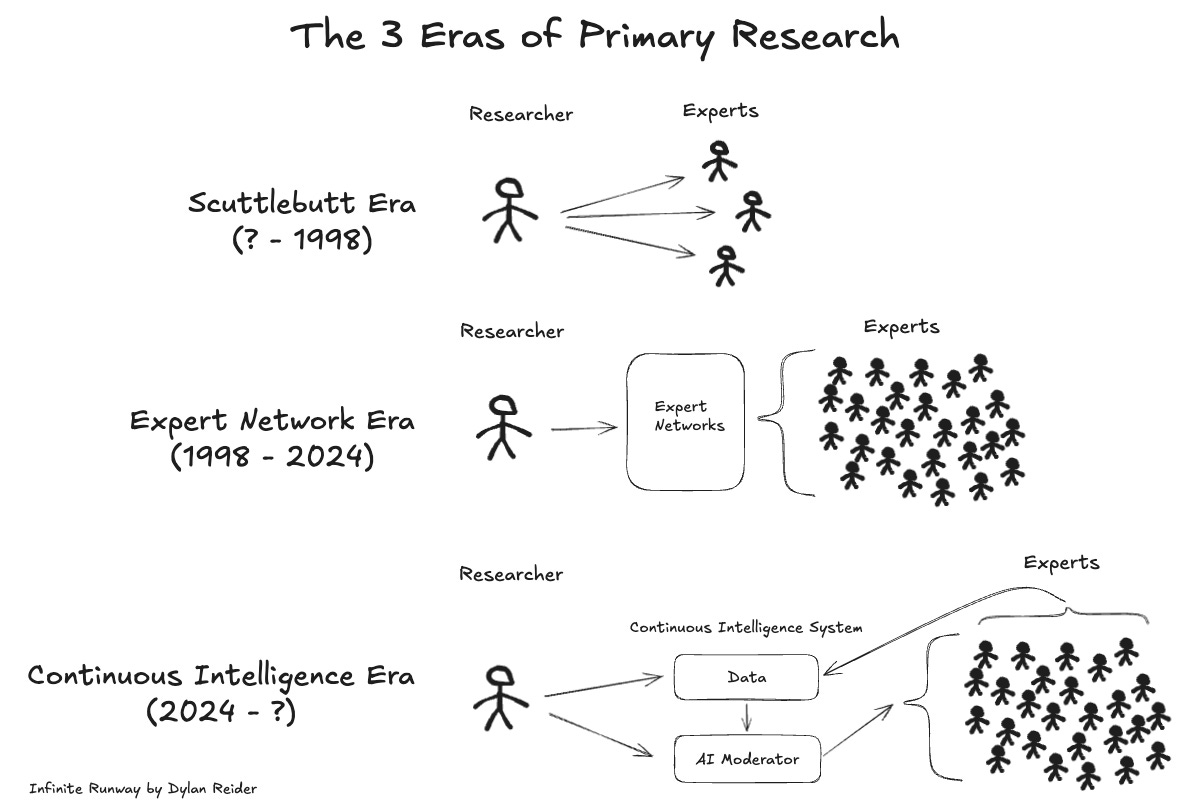
Qualitate doesn’t commoditize the expert or the call. Both are irreplaceable. A great expert who gives great information is still a high signal source of alpha. The structure around the calls is what changes. The unit of consumption is no longer a single call or transcript. It’s the aggregate - all of the calls packaged into a structured dataset that is queryable in natural language. Every future conversation builds on the last one, and the insights compound.
That is the scarce resource of the third era - the data itself - the continuously growing corpus of structured insights, and the AI that sits on top of all that context.
Unlike the relationship or the expert call, the dataset compounds. More conversations make the dataset larger. The larger dataset makes the AI sharper. The sharper AI asks better questions in the next conversation, which feed the dataset, which sharpen the AI. Each layer makes the one above it harder to replicate.
Qualitate will win the third era by owning the research workflows that come after the call. The platform, the dataset, and the AI trained on top of it get packaged into a product that answers any question about any market.
As the models get better and the dataset gets larger, the AI will get better at identifying what answers don’t exist yet, and what questions to ask them. And that intelligence will live inside the workflows of every firm that used to buy expert calls one at a time.
If the expert networks of Era Two sold hours, then Qualitate sells the accumulated intelligence of all of them.
Joining Qualitate full-time
The small coffee house on the Thames is now a lot bigger.
The edge is still there - it’s just no longer a phone call with a channel partner in Chicago or an hour-long GLG call. Now it is an always-on AI, building a primary intelligence database that expands with every conversation.
After two years of supporting Sagar and the Qualitate team, I’ve joined full-time as VP of Operations. It’s my first operating role in my career, after five years of venture investing and four years of sell-side equity research.
I’ve spent the last ten years running diligence processes by hand, the tried-and-true Philip Fisher playbook that every fundamental investor uses. I’m going to spend the next ten helping build the AI that powers that playbook.
Really enjoyed this one. Never knew the origin of Lloyd’s of London.
Would be a cool acquired episode