


Last week the tech world was ablaze with takes about Leopold Aschenbrenner, the 25-year-old founder of Situational Awareness, an AI-focused hedge fund. Leopold has been the poster child for the AI trade that has dominated the public markets for the last two years, or as Tim Ferriss put it, the “Nostradamus of AI.”
Leopold’s 2024 essay laid out the world’s accelerating trajectory toward AGI, published at a time when many people were decrying ChatGPT’s tendency to hallucinate and debating whether AI chatbots were a fad. He raised an initial $225M to act on that thesis, betting on the companies that would benefit from AGI and shorting the ones it would leave behind.
I believe all investment portfolios are expressions of a belief about the world that their manager has, and Situational Awareness was a pure expression of Leopold’s conviction in the development of artificial general intelligence and its impact on the economy.
And he was right about virtually everything. The capital intensity of the datacenter buildout. The binding constraints of power, memory and chip capacity. The rise of the neoclouds. And the challenges that software companies like Adobe would deal with in the face of AI.
His performance attracted institutional investors and the Situational Awareness fund swelled to $45B this year. In just the first half of the year it was up 439%.
On July 24 he wrote to investors that the sell-off in AI infra stocks this summer had created one of the best buying windows since early 2025, with the end of the letter inviting them to invest fresh capital. Before that could happen, a dramatic fall in the prices of AI stocks led to his fund getting margin called, and he was forced to sell his portfolio of public stocks to Ken Griffin’s Citadel at a 10% discount to market value.
His story is far from over, but for all he was right about, Leopold was wrong about one thing: how much leverage his portfolio could carry, and how much volatility that leverage would produce.
Borrowed Time
Leverage, or using debt to size up an investment, has wiped out brilliant investors and businesspeople for as long as there has been credit (thousands of years).
In the ‘90s there was Long Term Capital Management. They had two Nobel laureates and an incredibly sophisticated trading strategy, yet it only took four weeks for them to be wiped out (and a fantastic book was written about it).
In 2021, Bill Hwang’s $36B fund Archegos was famously unwound by too much leverage, so much so that Credit Suisse suffered a $5B loss that contributed to its eventual collapse.
Different people and different times. But in these stories, the players are the supporting actors and their investment theses just the scenery. The real main character: Leverage.
Readers of this blog know I’m a sucker for a historical analogy, and when it comes to too much leverage, American financial history is filled with examples.
In the 19th century, the infrastructure buildout of the day was railroads. And the financier who was most levered (and then over-levered) to it, was Jay Cooke.
Rail was booming in 19th-century America and Jay Cooke was one of the biggest financiers in the country. He underwrote $100M of bonds for the Northern Pacific Railway, couldn’t place them, and financed the unsold securities using his bank’s deposits. On September 15, 1873, he hosted President Grant at Ogontz, his 53-room estate outside Philadelphia. Three days later, a bank run forced Jay Cooke & Co. to suspend withdrawals, the New York Stock Exchange closed for 10 days, and America entered the Panic of 1873, a grinding depression that lasted six years.
Being right about the railroad buildout did not save the man who financed it.
Situational Awareness was a modern version of the same infra buildout trade, and the ending arrived faster (everything does relative to the 19th century). So what exactly was the trade?
Situational Awareness’ Bet
Situational Awareness’ portfolio reflected a maximalist view of AGI development. That its rise would be faster, more impactful and meaningful to the economy than markets realized. Its largest positions weren’t AI blue chips like Nvidia, Google, or Meta, but rather companies providing services that were bottlenecks in the AI supply chain.
That differentiated thesis led to investments in publicly-traded companies in power, energy storage, the neoclouds, and chips, as well as an investment in privately-held Anthropic.
At the same time, Situational Awareness took short positions in software companies that it viewed as AI losers, like Adobe.
That type of long-short pairing is typically used as a hedge. Go long an asset you have a thesis in, and short a related asset or the broader market such that you cover your exposure if everything moves down in tandem.
But Situational Awareness had the same premise for both its longs and shorts, that AI would improve and become more influential in the economy.
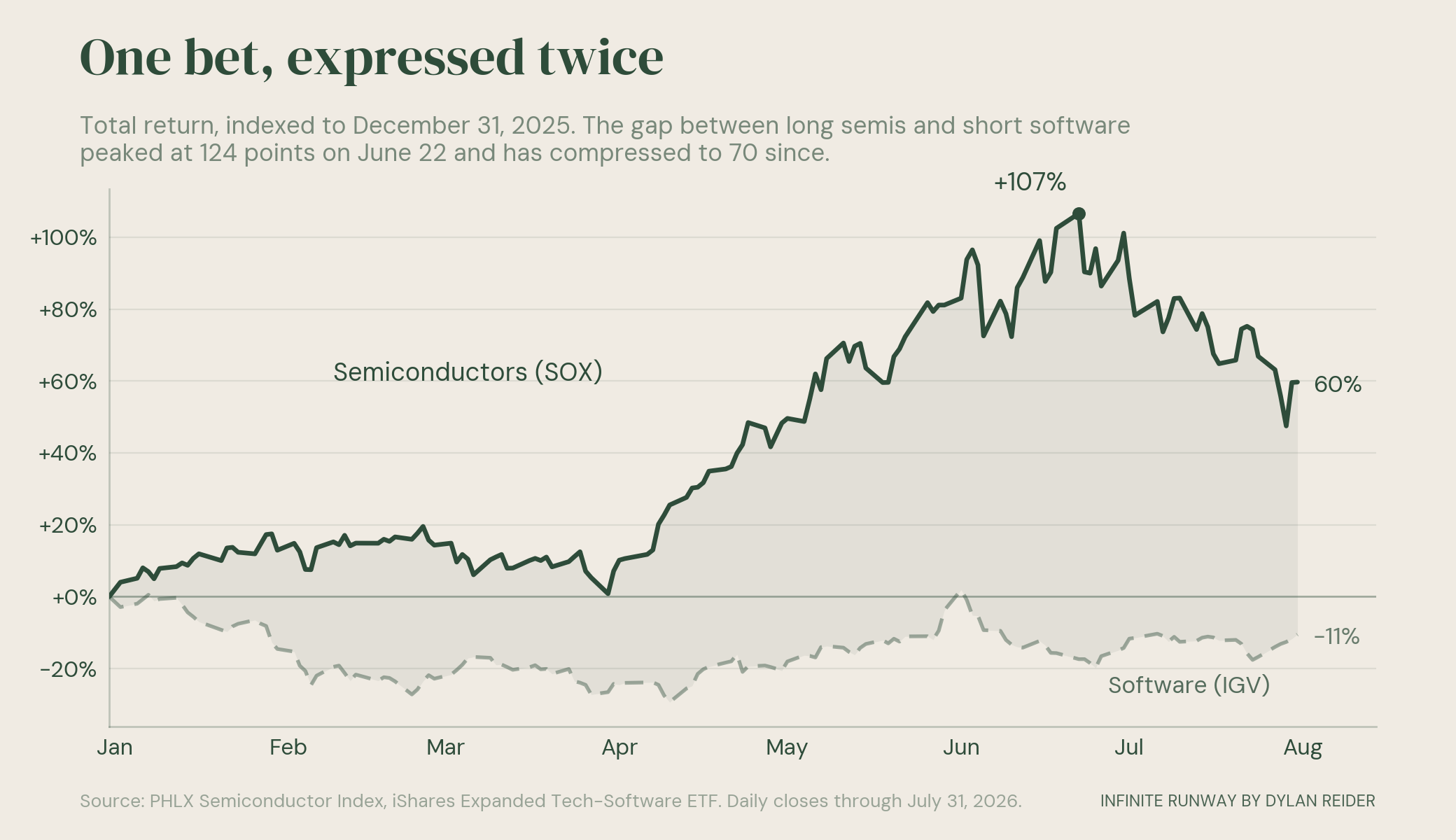
Semiconductors peaked at +107% on the year on June 22 while software sat at −12%. That 124-point spread was the trade, available to anyone with a brokerage account.
Indeed, many investors - both retail and institutional - copied Leopold’s trades. His 13F filings were pored over like gospel every quarter. A copy trading app called Autopilot ran a Leopold portfolio that thousands of traders followed. By summer 2026, Situational Awareness’ stock picks - Bloom Energy, IREN, Nebius - became household names among retail traders. So much so that the traders betting on them were often referred to as ‘bottleneck bros’ on X/twitter.
So Situational Awareness was right, but the long-short thesis that the fund was built on became the consensus view in the market. And they were running it at 4x leverage.
Broken Plumbing
As June rolled into July, the AI infra trade started to unwind. It was a perfect storm of overextended valuations, concerns about fundamentals following Broadcom’s conservative guidance, and competitive fears from improving Chinese chip technology.
Selling begets selling, and by the end of July, the AI infra names were having back to back 10% down days.
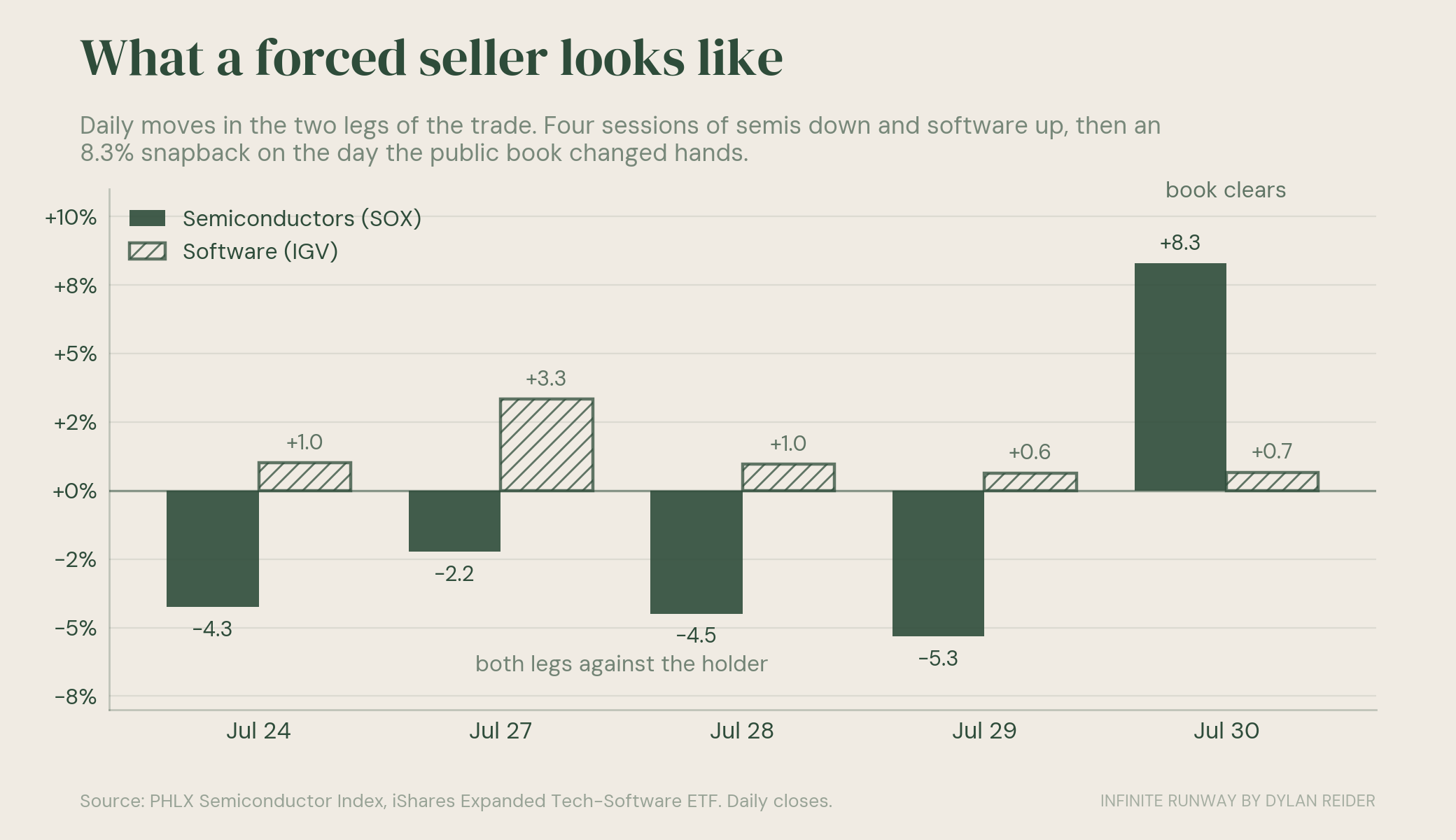
Then last week saw four consecutive sessions of semis down and software up.
Situational Awareness was forced to liquidate its public book by selling to Citadel last Thursday, July 30.
The story broke, and the next day saw an 8.3% snap back in semis.
Of course, one can’t tie these specific trading sessions to Situational Awareness’ unwind, but that trading pattern is consistent with a deleveraging: forced selling to pay back margin (debt).
What’s notable in this whole thing is it was all technical (related to stock prices), not fundamentally tied to the performance of the underlying companies.
The hyperscale cloud providers, Amazon, Google and Microsoft, all saw their cloud businesses accelerate this quarter, citing increased demand from AI.
This wasn’t so much a crack in the AI story as it was in the fund that predicted it.
A thesis-driven fund like Situational Awareness can go wrong three ways.
The thesis is wrong
The thesis is right but too early. Julian Robertson closed down the Tiger Fund in March 2000 because he couldn’t make sense of the dotcom bubble, weeks before the market peaked and then imploded
The thesis is right and the timing is right, but the structure was wrong. Too much leverage means you don’t survive long enough to see it through to the end. That’s where Situational Awareness now sits.
The two vectors here are accuracy and duration. Are you right, and can you hold on long enough for your thesis to play out. If you can’t, then right or wrong - it doesn’t matter.
Cooke’s version was underwriting a decade-long railroad buildout with deposits that could be recalled in a morning.
Situational Awareness’ version was running 4x leverage on stocks that had run up as much as 6x YTD (like Sandisk was up until last month).
At 4x leverage, a 25% down move results in a 100% loss, taking out your entire equity position. The semiconductor industry fell nearly 30% from its peak. Leopold’s original essay’s vision for AGI’s impact on the economy is playing out, but he structured his fund in a way such that he couldn’t see it through. Situational Awareness’ margin agreement got tested faster than their thesis did.
No matter how right your thesis is, ultimately it’s constrained by your funding terms, your leverage tolerance, and your LPs patience.
The Third Constraint
That rule doesn’t stop at funds. Companies have holding periods too, set by their balance sheets.
Scott Goodwin, the co-founder of Diameter Capital, put it well this week on twitter (worth reading the full thread):

Scott’s main point in his thread: For all the talk about AI right now, more people should be talking about leverage, and the market is increasingly separating out those who are over-levered.
If the first two constraints on the AI buildout were chips then power, the third constraint may be financing.
Debt financing has become central to the AI infra buildout. AI capex debt is approaching 15% of investment-grade bond issuance.
Credit spreads for the hyperscalers and adjacent capex-intensive AI companies have widened, signaling that the market is pricing in a higher degree of financing risk.
A lot of market observers, Goodwin included, have drawn parallels between the vendor financing conducted by Nvidia and Broadcom, and Nortel, Lucent and Cisco during the telecom bubble in the ’90s. Back then, they financed their customers’ purchases of telecom equipment. Now, it’s GPUs and chips being financed. In both cases, it moves the credit risk from the buyer to the seller.
Nvidia is a very different company today than Nortel or Lucent was back then. Nvidia is generating 70%+ gross margins on over $200B of revenue.
And yet, last week put a magnifying glass onto an AI infrastructure trade thats garnering increased scrutiny. As debt grows, more investors are simultaneously acknowledging that the financing behind the AI infrastructure buildout is not invincible.
Situational Awareness failed because of portfolio construction, not because the AI infrastructure financing system is beginning to crack. Nonetheless, it was a reminder that a long-duration thesis can be destroyed by short-duration financing structure. But in the meantime, widening credit spreads are actually healthy - the mechanism by which an investment buildout avoids being a bubble.
Every portfolio is an expression of a belief about the world. Leopold’s belief is intact, even if Situational Awareness’ public book is not. But the fund still holds a $5B position in Anthropic, and they have the network, access, and thesis to build the firm back.
Jay Cooke’s story didn’t end with the Panic of 1873. By 1880 he had rebuilt his fortune in silver mining. And in 1883, the Northern Pacific reached Tacoma. The railroad got built.
Great read as always. Which of the players do you think would have the highest risk of default due to being over levered?