


This Thursday, Anthropic is expected to go public in what will be this year’s Super Bowl for the worlds of tech and finance.
Anthropic launched Claude in early 2023. From launch through March 2026, the company generated $9.7 billion in total revenue.
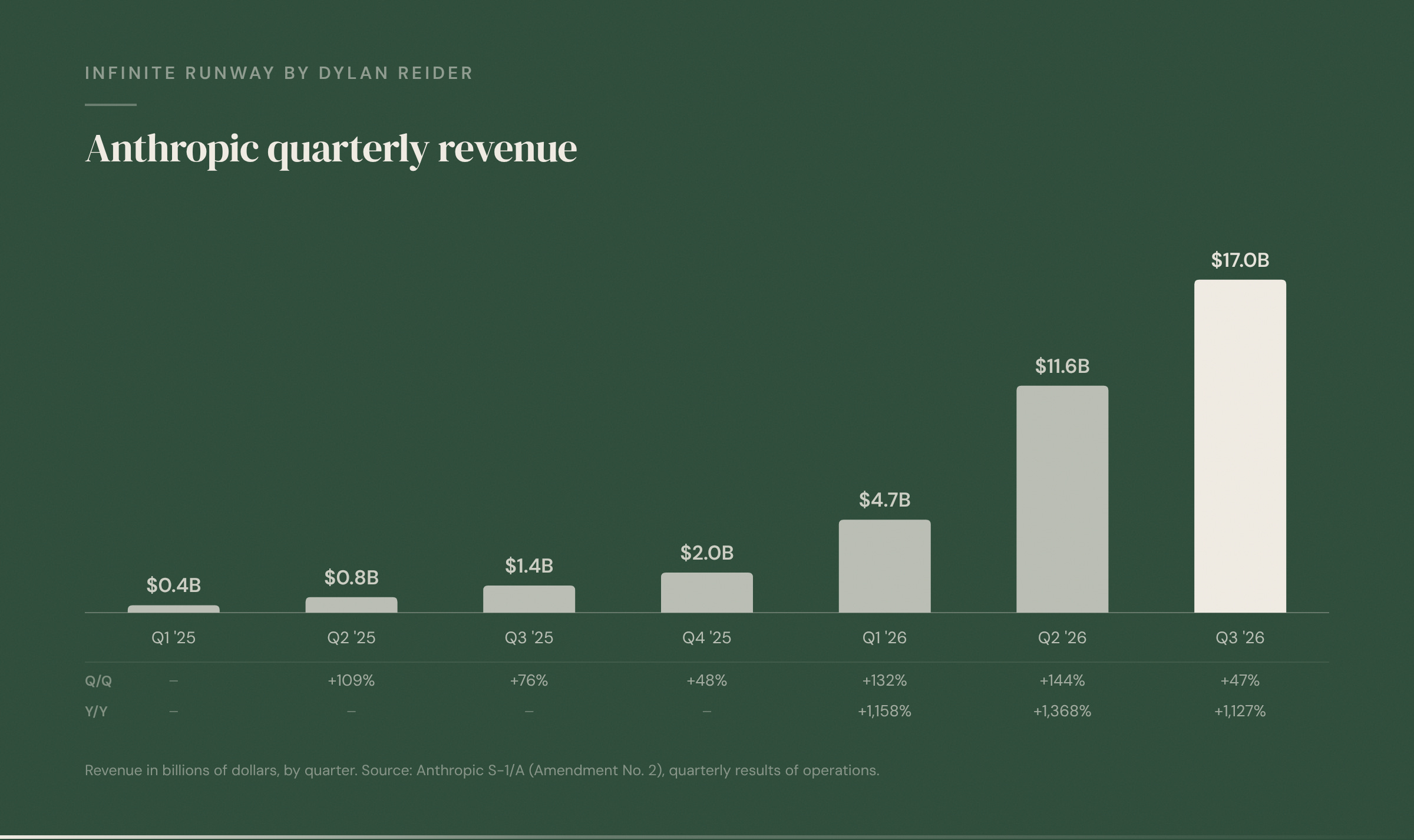
Then in 2Q of this year, Anthropic generated $11.6 billion of revenue. One quarter - bigger than the company's entire history before it.
So it’s no surprise that there have been a lot of takes about Anthropic in recent weeks, especially since October 26 when they dropped their S-1, the document a company files with the SEC prior to going public.
For this post, I’m focused on the business - how Anthropic makes money, what it costs to keep growing, and what investors might value it at as a public company.
Since the initial filing, the vibe in the market has shifted materially.
The stock market lost $2.5 trillion in value on November 5, and many tech stocks that have exemplified the AI trade are down 30-50% or more. Jensen has stepped down from Nvidia (for now?). And many are starting to wonder whether the AI trade is officially kaput.
These jitters have left their mark on Anthropic’s IPO.
The company’s roadshow with investors has left us with an estimate on the deal: $70 to $78 a share, about $1.4 trillion fully diluted, well short of the $2 trillion bankers had originally floated.
And on Friday, CEO Dario Amodei told JP Morgan’s Jamie Dimon on a livestream that "compute is the deepest business dilemma that the company faces." In their Q3 disclosure, compute costs jumped 77% Q/Q.
That dilemma is the central tension in Anthropic’s business.
ANT bulls will tell you the company is the greatest software company of all-time, while bears will tell you it’s a levered play on the compute bubble.
Reality, as it is so often, is likely somewhere in between. And I expect it to trade as such.
Because Anthropic’s financials, at least at face value, imply an incredible software-like 86% gross margin.
But it has capital intensity more akin to a chip fab.
On a per-token basis, profitability seems strong. But frontier AI models as a product have an expiration date - over 80% of Q3 revenue came from models released in the prior 6 months.
Which means Anthropic operates like a factory, contracting and paying up front to build the next AI model.
Running on a treadmill requires consistent energy output. Staying on the frontier of AI requires consistent capital output.
And right now, the capital Anthropic has committed to stay on the frontier treadmill adds up to $900B (though some of that is cancelable/subject to conditions).
Which means Anthropic is patently not a software company. So the lens we use to analyze it - its margins, capital, valuation multiple, etc. - is different.
Let’s get into it.
Founding Story
In 2021, seven members of the OpenAI team departed to start their own AI company. Dario Amodei, Daniela Amodei, Tom Brown, Jack Clark, Jared Kaplan, Sam McCandlish, and Chris Olah.
Dario had run research at OpenAI, Brown was lead author of the GPT-3 paper, Kaplan co-authored the original scaling-laws research, and Olah pioneered interpretability, the study of what’s actually happening inside a neural network.
Their founding thesis was predicated on the scaling laws - that scaling compute would keep producing more capable models. It was also predicated on safety - that those models would become powerful enough that the company building them should be organized around safety from day one.
Anthropic incorporated as a Delaware public benefit corporation in January 2021, and all seven co-founders are still there.
Product
Anthropic sells intelligence in three layers, each built on the one below:
Models. Mythos (including Fable), Opus, Sonnet, and Haiku - in order from largest to smallest model. Each one is classified along what Anthropic describes as the capability-cost-speed curve. The larger Mythos-class models are more capable, but also slower and more expensive.
Claude Platform. The suite of composable primitives, including APIs, context management, agent infrastructure, harnesses, etc., which allow businesses and developers to build more customized AI tooling.
Direct Applications. All of the software applications that Anthropic builds on top of their models using the Claude Platform - including Claude Code, Claude Cowork, Claude Design, Claude Security, and industry solutions.
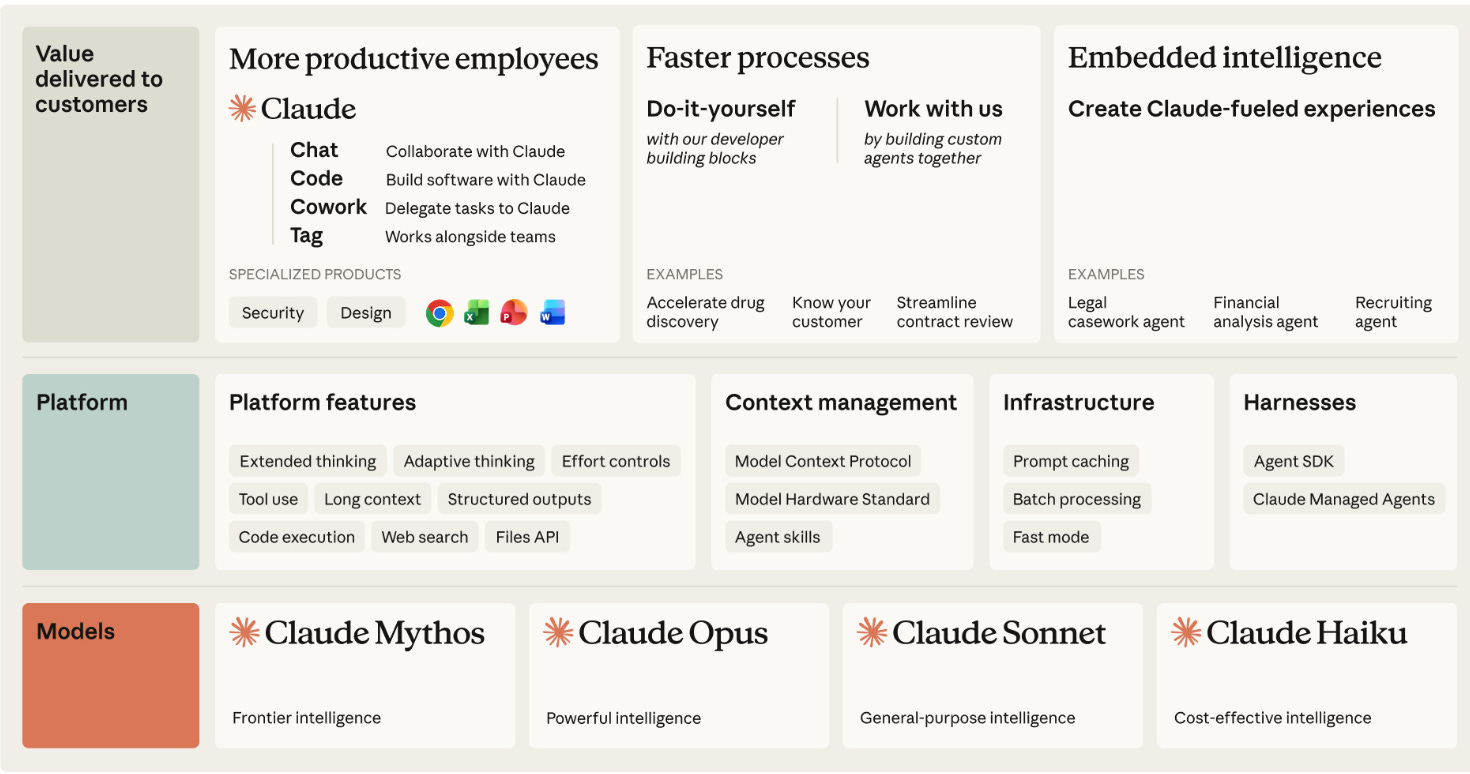
As Anthropic develops each layer more comprehensively, they reinforce each other. Over 50% of customers that spend $100K+ annually use both the Platform and a first-party app in 3Q26, up from ~30% in 4Q25.
The Frontier Treadmill
The world’s largest chip fab, TSMC, offers a useful way to think about Anthropic.
Staying at the leading edge requires TSMC to spend tens of billions per year. That investment produces more advanced manufacturing processes, attracts customers building the next generation of chips, and funds the next round of investment.
The moment TSMC stops spending money to stay at the leading edge of chip development, someone else will take the mantle, and their profits with it.
TSMC didn’t luck into that position on the leading edge of chip fab. They took it from Intel 8 years ago, a culmination of multiple strategic decisions made by each company.
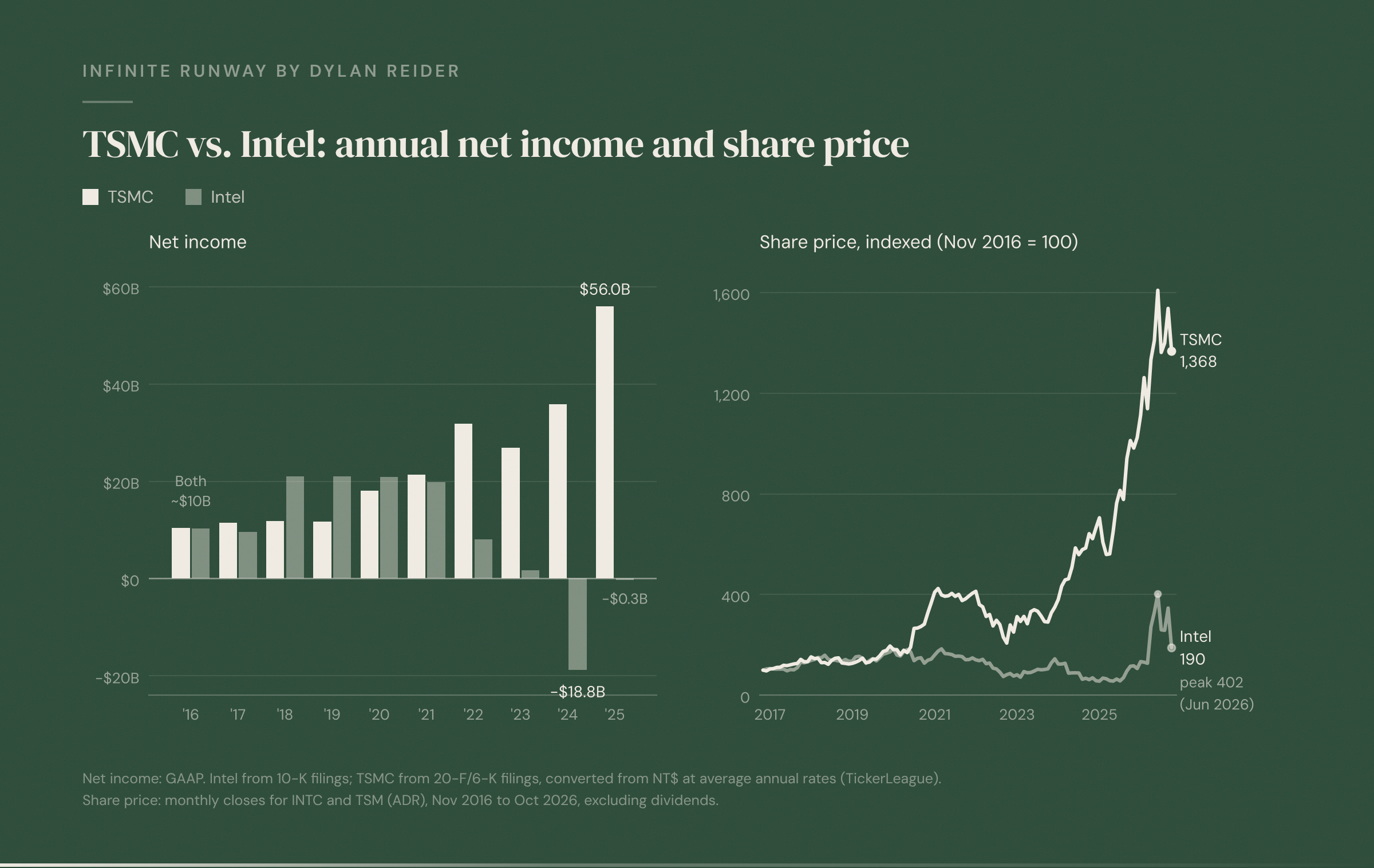
Frontier AI, though a much younger technology than the decades of history of chip development that we have, seems to operate on the same physics. Albeit model releases seem to be on 6-month timelines vs 2-year timelines for chips.
The treadmill, or investment cycle, looks like this:
Product adoption, and expiry. Customers adopt the newest model nearly as soon as it ships. Last season's model increasingly trends towards commoditization as prices fall.
Up-front compute investment. Most compute is procured 12 to 18 months ahead, under contracts Anthropic pays for regardless of usage. The bill arrives in large steps, before the revenue it supports. If Anthropic’s demand for compute outruns the supply they’ve procured, then they buy short-term contracts on the spot-market at a premium price.
Capital raises. Anthropic has raised $141.1 billion to-date, and had $146.6 billion of liquidity at the end of September, plus $77 billion of untapped note capacity from its partners. The IPO and a private placement alongside it add about $85 billion more to its balance sheet.
Frontier Labs vs. Fabs
The lingering question for a business that spends like this is: what’s left if the treadmill slows or stops, and it loses its position at the frontier?
For TSMC, it would still own the world’s most advanced chip fabs, customers whose chips are designed around its process, and years of cash flow from factories it has already paid for. After all, TSMC’s 7nm process went into volume production in 2018 and still brought in 14 percent of wafer revenue in 2025.
Eventually though, TSMC’s business would decay, just like Intel’s did when TSMC surpassed it.
If Anthropic stopped spending, its models would be last season’s in six months. Its leases would keep running, and its customers could switch fairly easily.
At TSMC, the cost of leading edge chips has become a moat. Each chip generation costs more, the know-how carries forward, and moving a chip to another foundry means redesigning it. The higher the price of the leading edge, the fewer companies can pay it, which is how TSMC earned $56 billion in 2025, more than its record $40.9 billion of capital spending.
At Anthropic, most of the $901 billion rents hardware that competitors rent too, and training is expensed into a model with a six-month shelf life. The sheer cost of maintaining a seat at the table keeps new entrants out, but OpenAI pays the same suppliers, and two of them, Google and SpaceXAI, are also rivals. And because compute is scarce, those suppliers get to name their price. Meanwhile some of these same suppliers, TSMC among them, have agreed to buy $26 billion of ANT stock at the IPO price.
The bull case offers two potential moats.
The first is the research loop. Revenue per compute dollar has more than quadrupled since early 2025 (though it dipped in Q3), and Claude wrote more than 90% of Anthropic’s code in September. So if each model speeds up the next, the lead compounds - the same way TSMC’s know-how did.
The second is the layer above the model. NVIDIA doesn’t own a single fab, and yet it still has a moat - in part from CUDA and the software developers who have written against its chips for nearly two decades. Anthropic’s equivalent is its apps (Claude Code, Cowork, Design), which sit on top of its platform and get better every time the models do. More than half of its $100K+ customers already use both.
Anthropic is still a young company though. So until one of these potential moats proves to be durable, Anthropic’s lead is only as good as its next model.
Business Model
Anthropic makes money two ways.
Consumption, or pay-for-intelligence (79% of revenue). Customers pay per token, priced by the model they choose: $26.3 billion of the $33.2 billion in the first nine months of 2026. More enterprises sign annual or multi-year minimum commitments, but revenue is recognized as tokens are consumed.
Subscriptions (21%). Claude Pro and Max for individuals, plus Team plans for organizations: $6.9 billion in 2026 through September. Subscribers who hit their limits can buy more intelligence on top, which bridges into consumption.
Public investors already know this from software companies with consumption-based pricing, like developer tools businesses such as Snowflake, DataDog, and Twilio - but this pricing model is a double-edged sword. It can scale up quickly when customers use more of your product, but it can also scale down quickly.
That volatility shows up in Anthropic’s financials - in the two weeks ending January 2, 2026, customer spend fell about 20% as companies entered holiday code freezes.
Anthropic’s pricing is also highly deflationary. With each new model release, intelligence becomes cheaper. Claude Opus 5.5 cut customers' cost per task by about 40% versus Opus 5.
Between Q2 and Q3, price cuts on new models and contract discounts took about $600 million out of revenue, and usage added $6 billion back.
This is Jevon’s paradox in practice - costs go down leading usage to go up, and so far that increased usage has offset lower prices to contribute to Anthropic’s revenue growth.
Go-to-Market
Anthropic runs the most efficient enterprise sales motion I’ve ever seen, and it’s worth any AI startup studying it.
On one hand, it’s classic product-led growth. On the other-hand it’s not, because the depth which Anthropic can be embedded (and thus the prices it can extract) in its customers without them ever speaking to the company is far deeper than what any PLG company has ever been able to attain. That’s at least in part because they’re selling intelligence, which has broad applications that are becoming more effective as their intelligence rises.
The wedge is developers. Software engineers adopt Claude, often through Claude Code, and become internal champions within their developer organization.
Non-technical users do the same, outside of engineering.
At their largest enterprise customers, Anthropic provides forward-deployed engineers to help with organization-wide adoption. While partners across the software and consulting ecosystems do the heavy lifting of integrating Claude into a company’s processes and workflows.
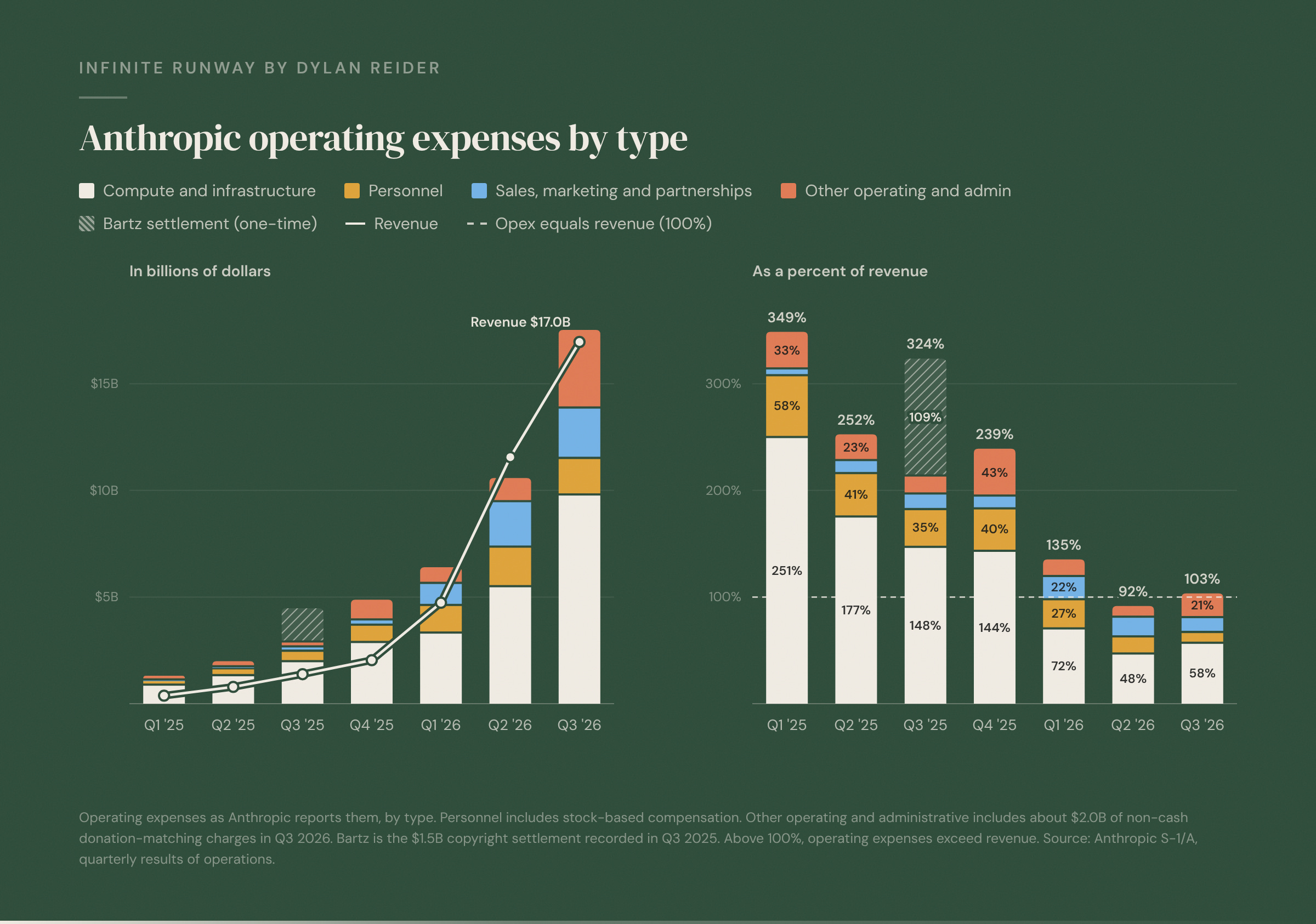
Sales, marketing, and partnerships expenses fell from 22% of revenue in Q1 to 14% in Q3. That improvement partly reflects a lower share of revenue coming through channel partners and changes in distribution terms. It’s encouraging, but this expense bucket reports personnel separately, so it isn’t directly comparable with the full sales-and-marketing expense of a conventional SaaS company, which is typically 30%+.
Revenue and Compute
Anthropic's revenue growth has been nothing short of astounding.
$41 million in 2023
$386 million in 2024
$4.6 billion in 2025
$33.2 billion in the first nine months of 2026
Q3 revenue of $17.0 billion was up 1,127% year over year.
But behind that revenue growth, the real story is compute efficiency.
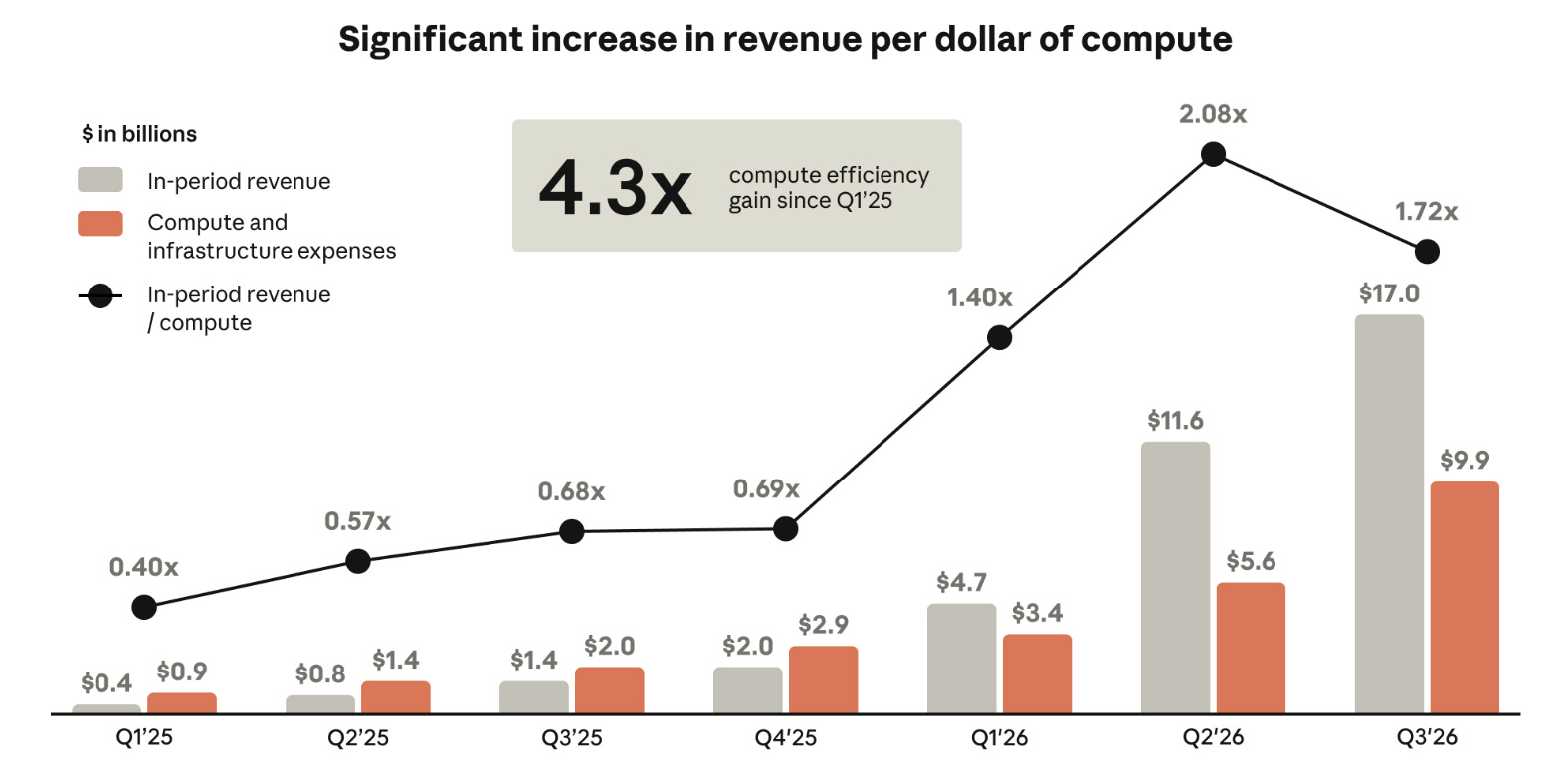
In 1Q26, Anthropic generated more revenue than it incurred in compute costs, and one quarter later revenue was more than double compute costs.
Each dollar of compute produced about $0.40 of revenue in Q1 2025, compared with $2.08 in Q2 2026.
The 2025 debate about the unit economics of frontier AI companies has been settled.
However, as I wrote about earlier, staying on the frontier is messy, while the costs are unwavering.
In 3Q26, Anthropic grew revenue by 47% Q/Q to $17B, that’s a $68B annual run-rate and roughly in-line with OpenAI’s reported $70B.
That’s a slowdown relative to quarters prior, as Q3 added $5.4 billion vs. Q2’s $6.8 billion of quarterly revenue.
Part of that slowdown may have been due to OpenAI’s model capabilities catching up to Anthropic, with the GPT-6 launch in early September.
Meanwhile, compute costs jumped 77% in a quarter to $9.9 billion, or 58% of revenue. That includes $5.0 billion of short-term compute that "currently costs significantly more" than Anthropic's multi-year contracts. Revenue per compute dollar fell from $2.08 to $1.72.
To put it plainly, in 3Q26 demand outran the compute Anthropic contracted 12-18 months earlier. So it paid spot prices for $5B of short-term compute to keep serving customers, which led adjusted margin to fall four points.
Before we start getting bearish, it’s important to keep things in perspective - run-rate still grew $10B in October alone, and 47% Q/Q maths out to 350% per year.
Now, 4Q has seasonal slowdowns with the holidays. Anthropic is also cracking down on distillation (competitors, many in China, paying for their API to build their own model).
Both of these factors will create revenue headwinds that investors will have to be aware of. We’ll need another quarter with 1Q27 to judge whether we’re hitting a near-term consumption-ceiling with revenue beginning to flatten out.
Personally, I don’t see that happening.
Margins and Profits
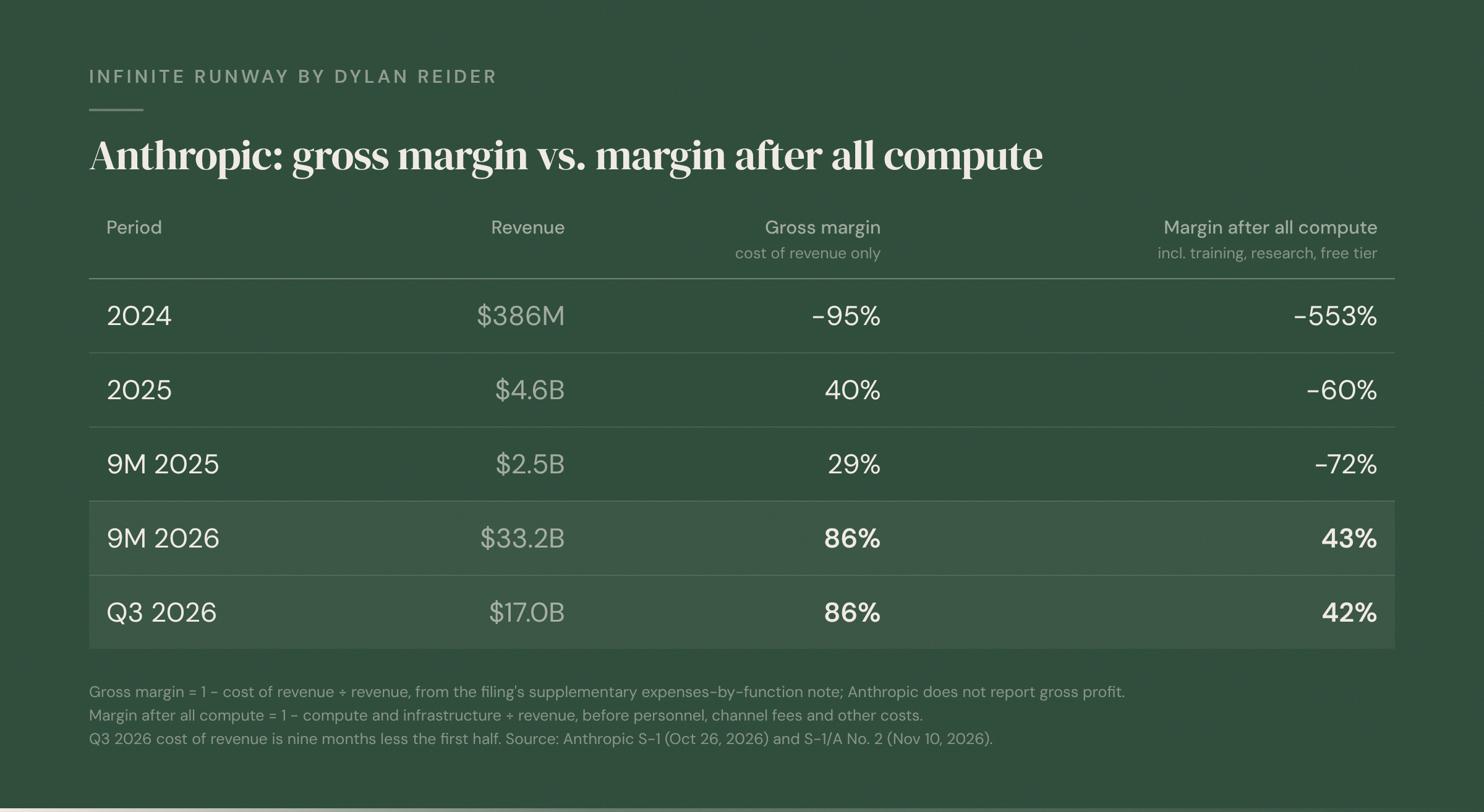
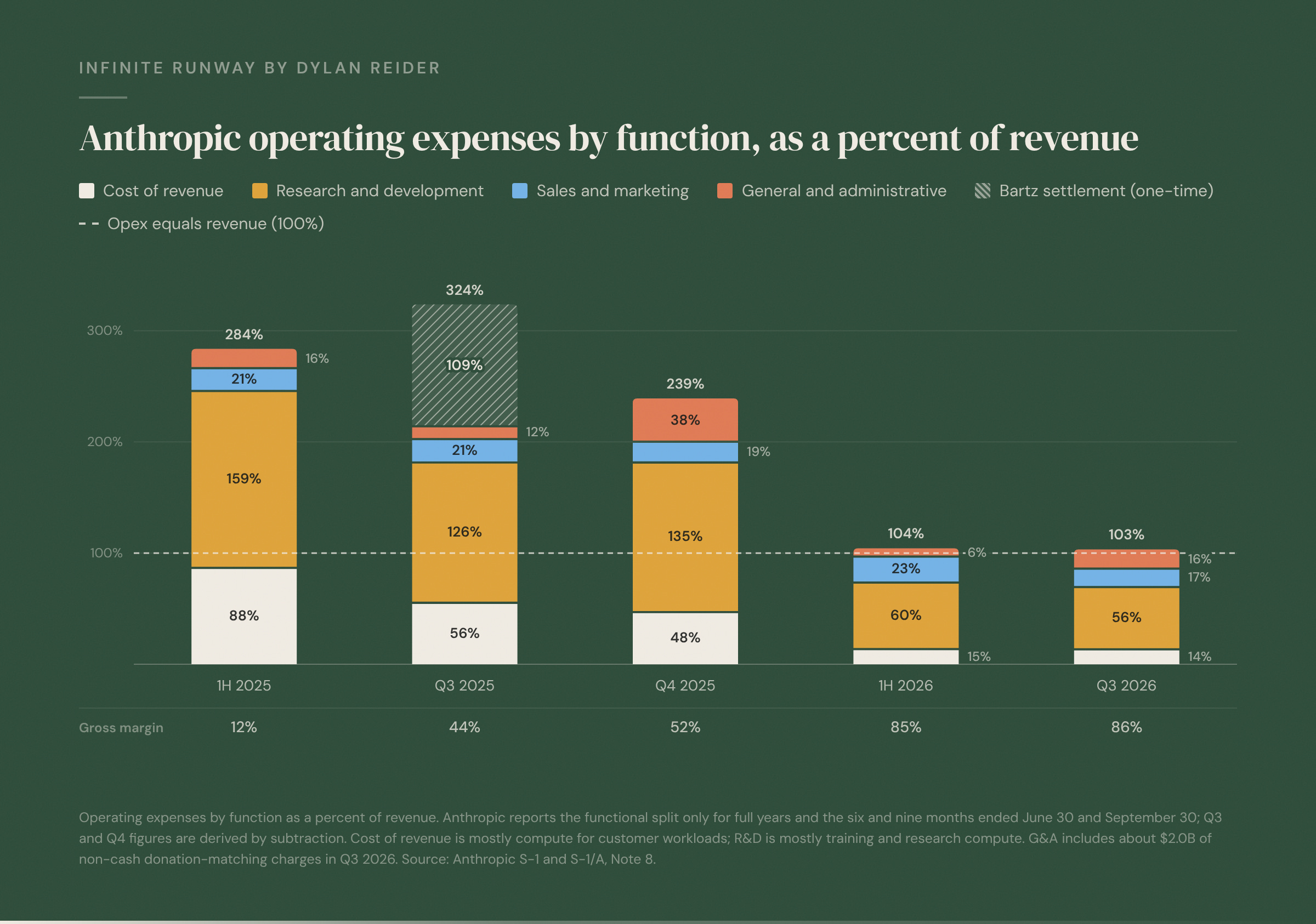
Gross margins. Calculating gross margins for Anthropic isn’t straightforward. While their costs are not presented in traditional functional buckets (COGS, S&M, R&D, G&A), they do disclose them in a footnote at the end of the S-1.
Taken at face value, they show an 86% GAAP gross margin for the first nine months of 2026, including during Q3’s compute spike.
That is elite SaaS territory. But let’s look what’s behind it.
Cost of revenue was $4.8 billion through September, primarily customer-serving compute, plus certain personnel and overhead costs.
On the other hand, compute for model development, research, and internal usage sits in R&D, while compute supporting free access sits in sales and marketing.
There’s another cost outside gross margin: distribution.
Anthropic recognizes cloud marketplace revenue before deducting the fees it pays its partners, which sit in sales, marketing, and partnerships. So the 86% gross margin doesn’t capture everything it costs to bring that revenue in. The clouds help Anthropic reach customers, but they collect a toll along the way.
Subtracting all compute and infrastructure expenses from revenue leaves approximately 43%, before personnel, distribution, and other expenses. I think that’s a useful measure of the economics of the whole model-development cycle.
However, that number still excludes those marketplace fees. So “true” gross margins are likely meaningfully different from the 86% that the company is presenting.
Operating margins. In 2Q26 Anthropic generated their first quarter of operating profits, $974M. But in 3Q26 they lost $567M from operations. Through September, the operating loss was $1.3 billion. On an adjusted basis, which excludes stock comp and Anthropic’s donation-matching expenses, the company generated $4.1 billion of operating profit, a 12% margin.
Net margins. Anthropic is early in its journey of profitability, but it’s not - as many pundits lacking financial literacy claimed - wildly unprofitable. Many people claimed Anthropic’s $104B net loss in September YTD reflected an immature company selling dollars for 90 cents.
In fact, about $94.3 billion of that net loss is the change in fair value of convertible notes, derivatives, and SAFEs. These convert into stock, so every time Anthropic’s valuation went up, so did what it owes the holders when it IPOs.
Another $10.4 billion of net other expense was largely driven by financing-related items
In totality, these largely non-cash financing-related items explain why the headline net loss is so much larger than the operating loss. Anthropic already generated $6.6 billion of operating cash flow through September, stronger than the headline net loss suggests.
Net-net, I think Anthropic is going to be printing cash soon enough.
Customers
Here’s an incredible stat - every Fortune 10 company, more than half the Fortune 500, and more than 30% of the Global 2000 spend $100K+ a year on Anthropic.
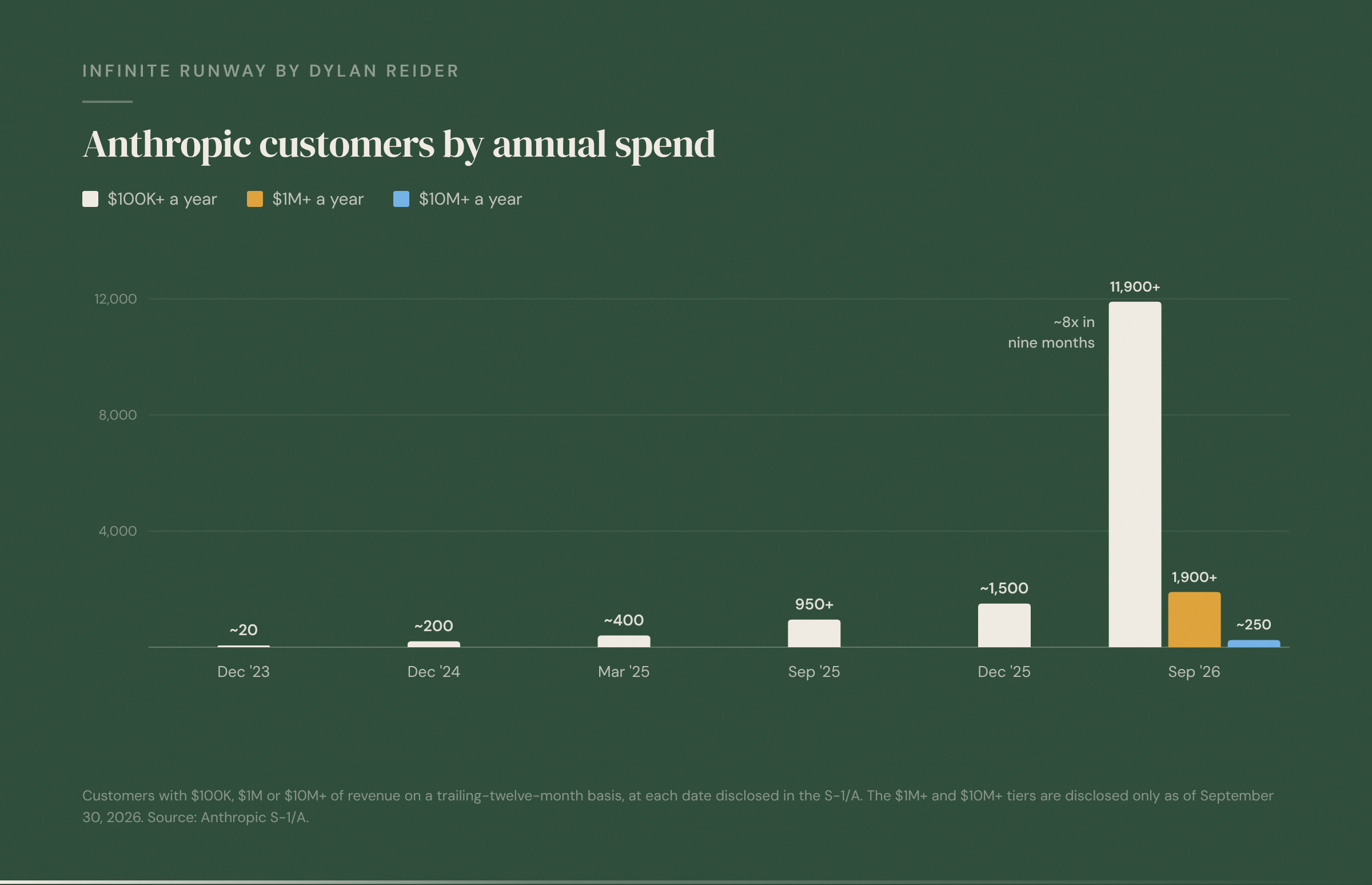
Those customers represent 11,900+ companies, collectively generating 74% of Anthropic’s trailing-twelve-month revenue, or $26.1 billion. Of that group, more than 1,900 spend $1M+ and about 250 spend $10M+. Roughly 40 million smaller customers make up the other 26%.
Customer concentration is also declining as the revenue base broadens. The top 5 customers represented 21% of 3Q26 revenue, down from 36% in 1Q26.
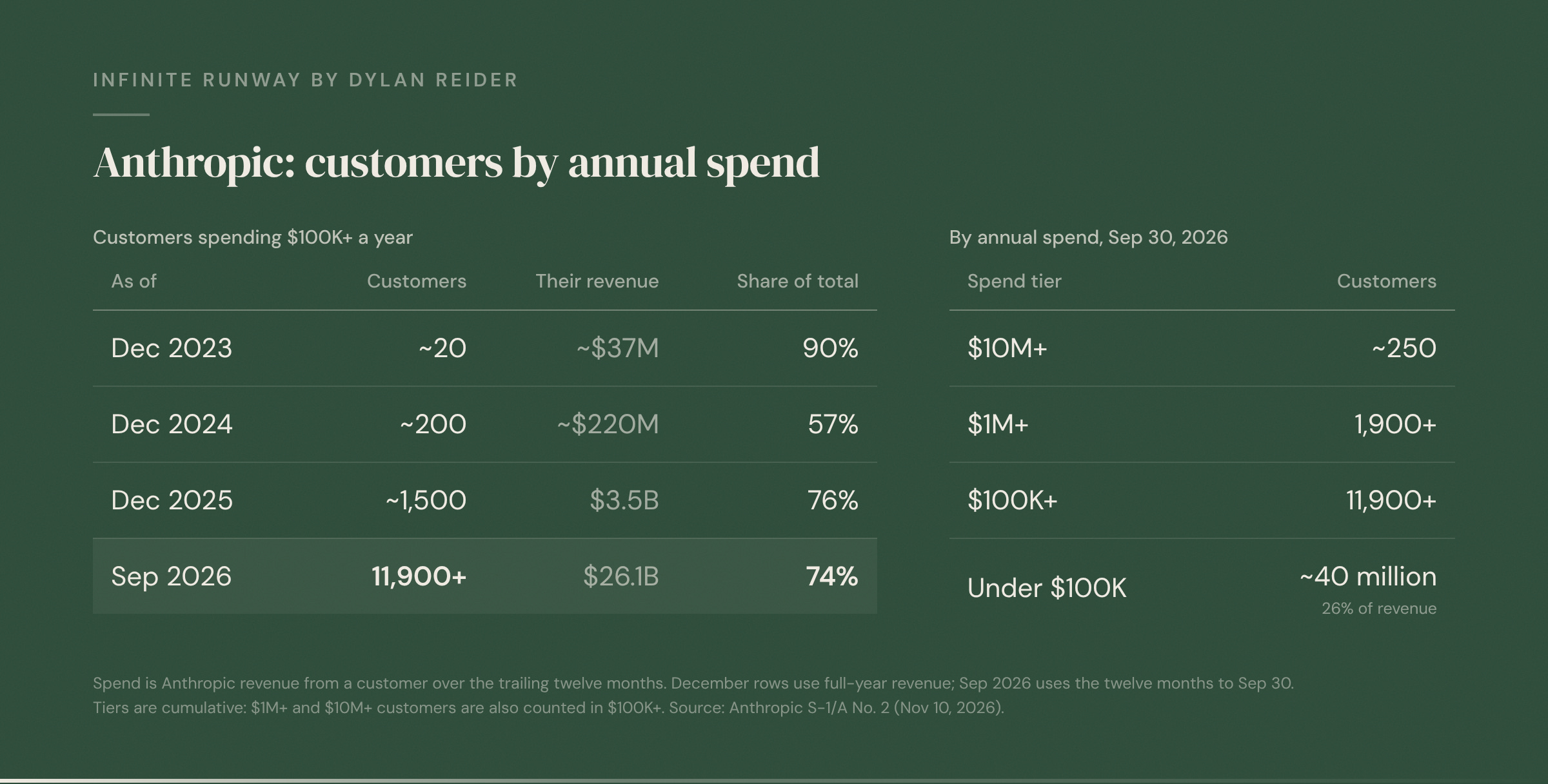
Net revenue retention is 900% - that might be the best NRR number I’ve ever read in an S-1. Plus, unlike many SaaS companies that try to game this metric, Anthropic's NRR actually includes churn and contraction, comparing last quarter's revenue from every customer that spent at least $1 a year earlier (excluding Pro and Max subscribers) with what they spent then.
The caveat: Starting from companies that spent at least $1 in the year prior means starting with companies that may be experimenting with Anthropic. So the 900% measures early adoption.
A more accurate reflection of expansion would be NRR only including customers with a certain usage threshold (dollars or user count).
An unusual commercial stat. Anthropic estimates 5–7% of revenue in the first nine months of 2026 came from customers violating its usage policy or commercial terms. Per multiple media sources, much of that was distillation, which we covered earlier: other companies paying for Claude to train their own models. Anthropic has stepped up enforcement in August and September, so that revenue is going away, and it will drag on Q4 according to what management has told investors.
A deep dive into $901B of compute contracts
Earlier I wrote about the $901B of Anthropic’s compute contracts. Those run through 2045, with about half of it ($451.6 billion) by the end of 2030. Here are the biggest named contracts:
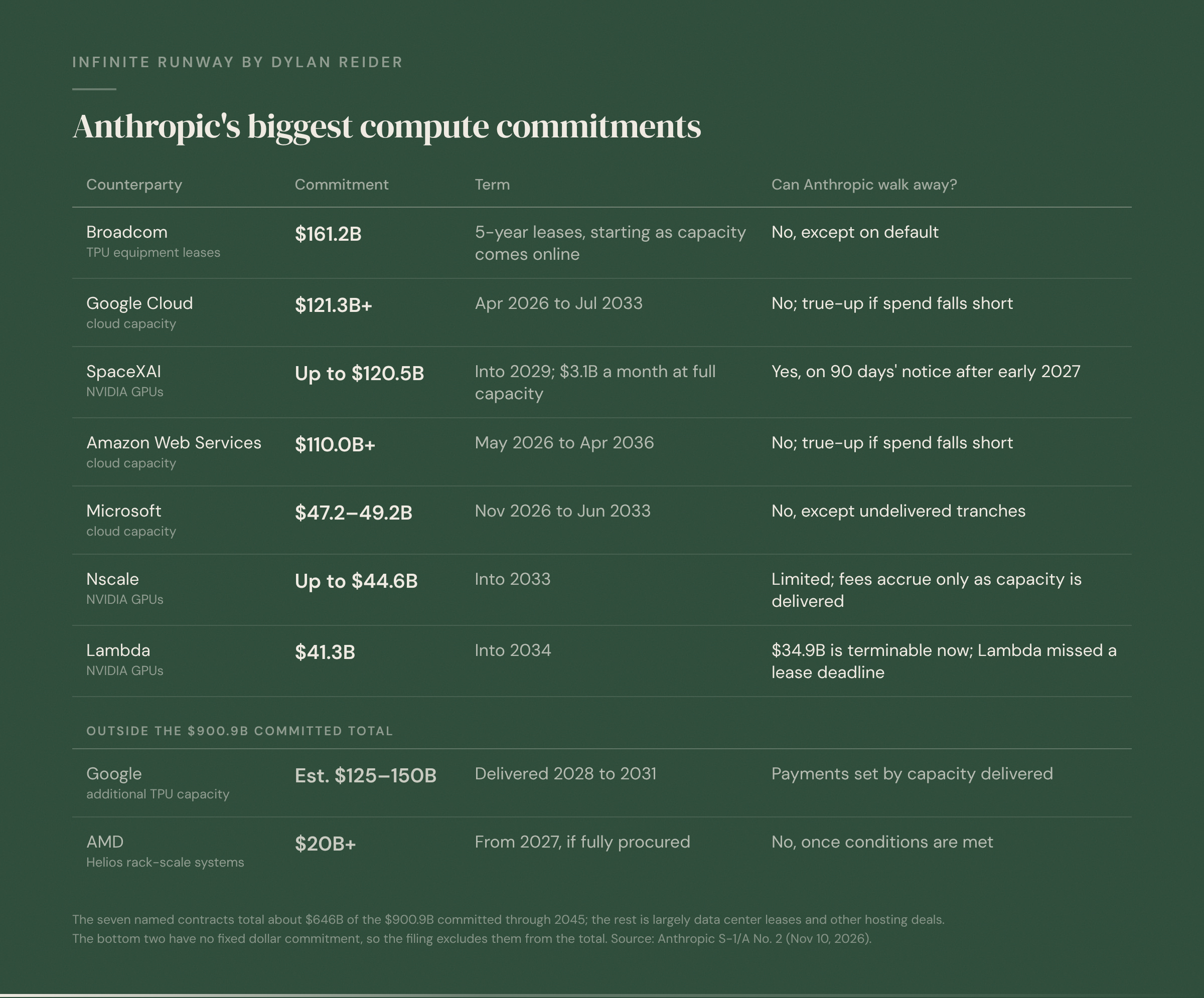
Those contracts in the table above only account for $646 billion, because the $900B figure also counts data center leases that haven't started yet, and $105.7 billion of commitments signed after September 30. The extra Google TPUs and AMD systems aren’t in the $901 billion at all, and would add another $150–175 billion
However, $186.2 billion, about a fifth of the total, carries termination rights or conditions, like the counterparty securing financing, facilities, or regulatory approvals.
Let’s go deeper into what we can learn from these compute contracts.
Compute commitments are growing. These costs grew from $5.6 billion in 2Q26 to $9.9 billion in 3Q26, and the SpaceXAI deal alone runs about $9.3 billion per quarter once fully delivered starting in December. Anthropic owes $70.7 billion over the 12 months after September 30, more than Q3's annualized revenue of $67.8 billion and 87% of October's $81 billion run-rate. So the revenue required to fund these commitments must continue to grow.
Anthropic is becoming its own hyperscaler. Anthropic is shifting from renting cloud capacity to leasing its own hardware, in what it calls Anthropic Direct. In this model, Anthropic leases their own chips, rather than renting the full stack from a third-party. The $161 billion of Broadcom TPU leases are the first big reflection of it. Over time, this could also fix Q3's margin problem, as Anthropic says dedicated capacity will backfill their expensive short-term compute needs.
Hot-swapping chips provides leverage. Anthropic trains and serves Claude on AWS Trainium, Google TPUs, NVIDIA GPUs, and AMD GPUs. It has its own orchestration layer that routes each workload to the best hardware for the price. So it can sign deals with Google, Amazon, Microsoft, SpaceXAI, AMD all at the same time, with none of these otherwise powerful suppliers able to hold them hostage. That optionality gives the company leverage in pricing negotiations.
Dario’s dilemma. As I mentioned earlier, Dario told Jamie Dimon that “compute is the deepest business dilemma that the company faces.” So what’s his answer to this dilemma?
Plan compute for roughly the 10th percentile of possible growth, buy on the low side, and top up on the spot market, which he said has always been there so far.
Over time, Anthropic may be able to overcome this dilemma through the strategies above.
For now, the bets may look irresponsibly large at first glance. Meanwhile, the hedges are offloading excess compute, efficiency gains, and raising capital.
Market Opportunity and TAM
It feels silly to write a TAM section for intelligence.
Alas, Anthropic puts the value of knowledge work at more than $40 trillion in 2025.
Most software companies size their market as a share of software budgets for that category.
Anthropic sizes it as a share of the work itself. AI labs are comping themselves against their customers’ payroll, a far bigger pool than their IT spend.
So a useful number here is revenue from Anthropic's Fortune 500 customers in Q3 averaged less than 0.1% of their total expenses. Its top 10 Fortune 500 customers spend less than 1%, still a sliver but more than eight times the average.
If the rest of their customers converge toward the top 10, that's years of expansion inside of accounts Anthropic has as customers.
The Bear Case, Steel-manned
There are some real risks in Anthropic’s business, beyond the hand-wavey “we’re in an AI bubble”.
Mismatched durations. A timeless risk in the corporate world is when companies raise money short and invest it long. WeWork had $47 billion of long-term lease obligations against roughly $3 billion of revenue. Anthropic has hundreds of billions in compute commitments, with a lot of that running into the 2030s, against consumption revenue that fell 20% over two holiday weeks, with only about $10 billion under contract for next year. Now, that represents contracted backlog, not a forecast of total revenue, because customers can consume substantially more without making long-term commitments. But it highlights the mismatch, Anthropic has committed to compute for years in the future, while much of its revenue depends on customers continuing to use - and expand their use of - Claude.
The model frontier may prove fickle, but model costs won’t. Revenue is concentrated in models less than six months old, so a model that misses or a rival that leapfrogs hits revenue within a couple of quarters. But the compute bill keeps coming either way. Given how quickly Anthropic overtook OpenAI, it’s reasonable to call into question the stability of Anthropic’s leadership today.
Dependence on partners that are more like frenemies. Nearly half of revenue flows through marketplaces run by the hyperscalers which are building competing models. And, those same companies supply most of Anthropic’s compute. Anthropic says it has sought more compute than its cloud providers were willing to provide. Reading between the lines suggests they could stifle Anthropic’s growth.
Commoditization, leakage, politics, and many more smaller risks. Open-weight models keep improving, price per task falls ~40% a generation, and third parties keep trying to distill Claude. Politics have become intertwined with tech, and politicians on both sides of the aisle have taken aim at AI companies as a boogeyman. And the list goes on.
Valuation
If you’ve made it this far, thank you.
Now the part you came for: How much of that risk is reflected in the IPO price, and where can we expect ANT to trade?
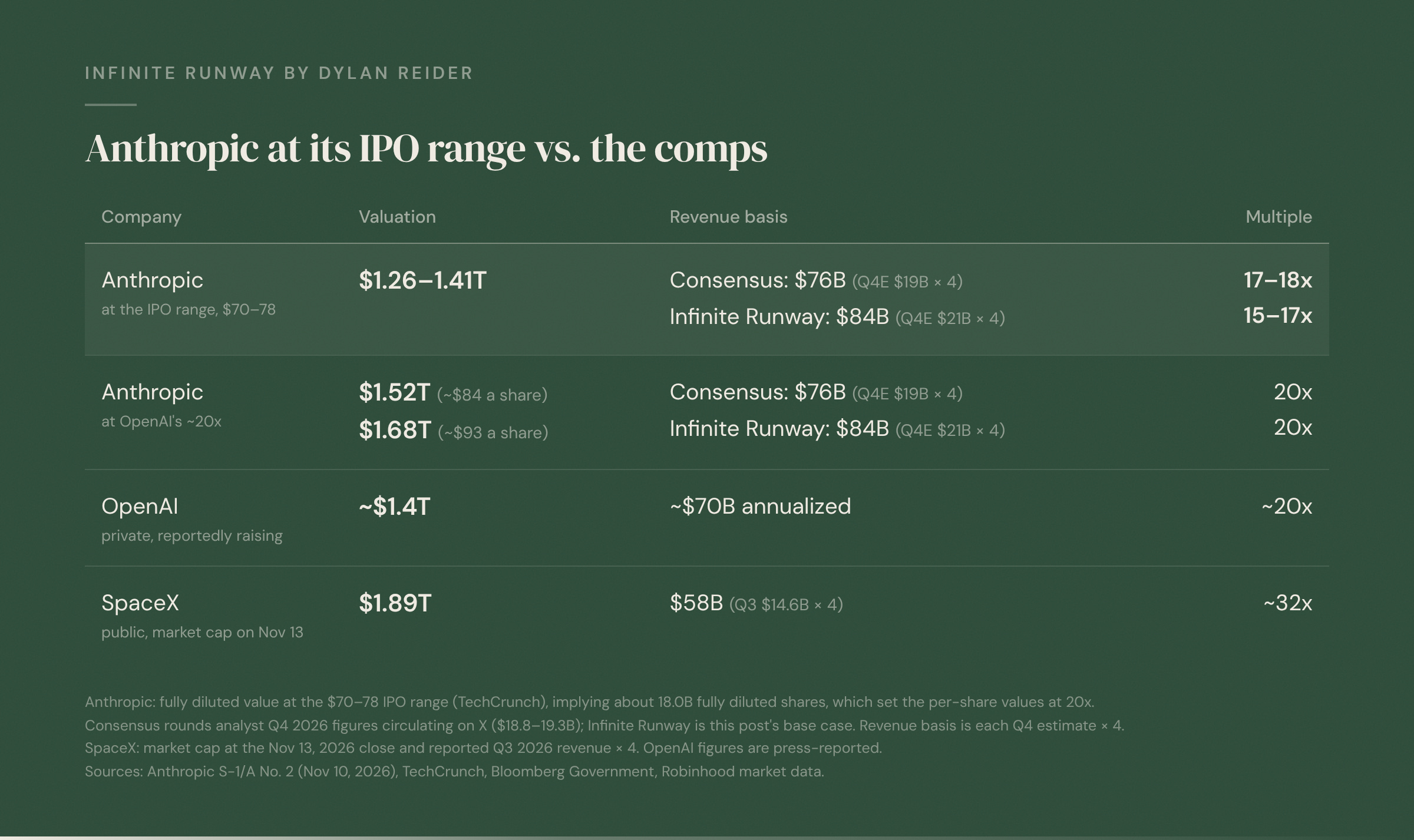
The price. Anthropic is selling 825M shares at $70-$78, which comes out to $61B at the midpoint. They’re also doing a $26B private placement at the same price. On a fully diluted basis, that implies $1.26–1.41 trillion. Relative to the Series H valuation in May, that’s a 26% premium - during which quarterly revenue tripled.
At one point, $2 trillion was the number being floated.
The market seemed to not be on board with that price. Likely for the reasons we covered: Q3 margin slip, $901B of compute commitments that Dario calls the company’s “deepest business dilemma,” and a serious macro debate about whether the AI trade is over.
And yet, operating profits may be at an inflection point, enterprise traction is still early in account penetration, and maybe most importantly - ANT is a scarce asset for the public markets. It is the only pure-play frontier lab public investors can buy, and the purest expression of the AI trade.
Estimates. Consensus seems to be converging on Q4 revenue at $18.8–19.3B. According to reports, Goldman Sachs is estimating $52B for 2026, implying $18.8B in 4Q26, (+11% Q/Q). Barclays is estimating $19.3B (+14% Q/Q). Both annualize to $75–77B, below the $81B run-rate Anthropic disclosed as of October 31.
According to the banks, the 4Q softness is being attributed headwinds that management called out in an investor call: holiday seasonality and usage softness, price cuts for Opus 5.5, and sequential deceleration after hyper-growth this year.
My bull case, which I still think is a reasonable estimate, is $21B. Anthropic’s run-rate hit $81B at the end of October. 1 month of that implies October revenue of ~$6.75B (+15% M/M). If November and December come in similarly around $7B each, Q4 will be around $21B. That’s 24% growth over 3Q26, down from 47% in Q3’s growth relative to Q2.
While consensus is pricing in several headwinds for 4Q, there are also tailwinds. The release of Fable 5.2, SpaceXAI’s compute coming fully online in December, the buzz around the IPO and continued sales execution could push monthly growth to closer to October’s rate than consensus assumes.
The multiple. There’s no clean comp for this business, which is often the problem with valuing the first to market.
At the top of its range, ANT trades at ~18x annualized 4Q revenue on the consensus estimates I mentioned, or 17x in my bull case.
That’s a discount to OpenAI’s 20x multiple at the $1.4T it’s reportedly raising at. However, one caveat in comparing the two companies is how they each account for marketplace revenue - reporting it before or after distribution fees changes the revenue. I’m treating the 20x as an indicative trading benchmark, but it requires closer consideration as OpenAI makes their own disclosures ahead of their own IPO in the future.
That said, put Anthropic on OpenAI’s multiple and it’s worth $1.5–1.7 trillion, or roughly $84–93 a share. That’s above the top of the range even on the analysts’ lower numbers. Against the $2 trillion chatter, it’s priced conservatively, and the founders seem fine with that.
The Founders’ letter passes on advice they got before the IPO: “never let your company be worth a dollar more than it is actually worth.”
My call. I expect ANT to price at or above $78. The book is reportedly six times covered, up to 20% is reportedly set aside for retail, and the float is only about 6% of the company. That setup is built for a first-day pop.
After that, given how volatile this market has been, it’s hard to say.
Multiples are shorthand for a real valuation based on discounted future cash flows. This section reflects where I think the market clears in the near term, and says nothing about my view of Anthropic’s long-term fair value.
Conclusion
Anthropic is the greatest startup of all-time.
The company was founded in 2021, and 5 years later it’s going public as one of the largest companies in the world, with the fastest at-scale revenue growth ever seen, in one of the largest wealth creation events of all-time.
The average Anthropic employee will be worth $41M at the IPO. Over 1,000 employees will make $100M+. As pointed out on X, there’s only ~11,000 Americans with $100m in investable assets.
The investors, like Yasmin Razavi, who backed Anthropic early, are printing billions for their LPs and their firms.
And beyond all of that, like every great startup, there was a great founding story of a small group of people who saw a better way.
As for the enduring value of the business, there’s still a long way to go, but as far as startups are concerned, the IPO is the crowning achievement, and nobody has ever done it remotely close to this scale or speed.
Now, Anthropic will have to prove to public markets that it has the capability to stay at the frontier, that it can forecast compute needs effectively and not let its commitments outrun demand, and that this whole AI thing is really just getting started. Game on.
Disclaimer: As of this post’s publish date, I’m not a shareholder in Anthropic. This analysis is for informational purposes only and is not investment advice. Please do your own research.